
“If you have a heart but no appearance, your appearance will follow your heart; if you have an appearance but no heart, your appearance will perish with your heart.” This timeless principle of physiognomy, from the extraordinary book *Ma Yi Xiang Fa*, reveals the ultimate secret of the relationship between facial features and destiny. Why do some people have a smooth life, seemingly blessed by heaven, while others suffer repeated setbacks and toil day and night? The wisdom of our ancestors tells us that the answer to all of this is actually already written on the face of each of us.
The human face, though small, is a “wordless book” containing boundless information about life. It is not only a barometer of our emotions but also a holographic microcosm of our life’s trajectory. From the moment we are born, our innate bone structure is largely determined; and as time passes, our character, virtues, and experiences, like a skilled sculptor, etch the marks of our lives onto our faces. This ancient Eastern wisdom, known as “physiognomy,” is not superstition but a philosophy of understanding people that integrates the I Ching, Traditional Chinese Medicine, statistics, and life information science. Today, let us unveil this veil together and learn how to decipher this most authentic “life script” on our own and others’ faces.
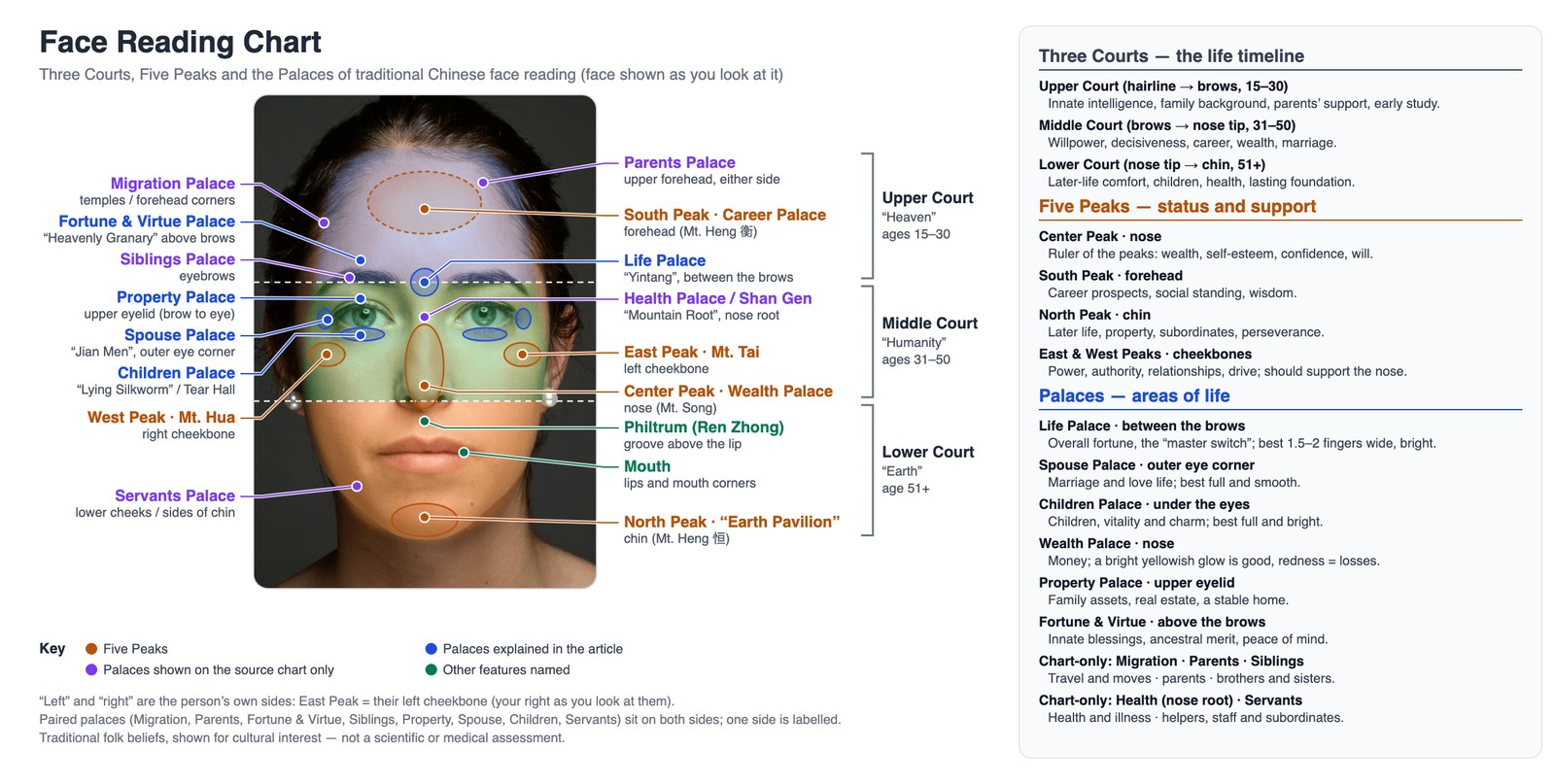
The Three Courts of the Face: Reading Life’s Rise and Fall
In ancient times, when people observed a person, the most important thing was their overall structure. A face, from top to bottom, can be clearly divided into three parts, which is the most basic and important theory in physiognomy: the “Three Divisions.” It is like a general outline of life, macroscopically depicting the ups and downs of our fortunes in our early, middle, and old age. Before dividing a face into sections, many readers first look at its overall outline, and our guide to the five face shapes explains the Metal, Wood, Water, Fire and Earth types.
The Upper Face: Wisdom and Foundation (Ages 15 to 30)
The upper part of the face governs the “springtime” of our lives. It represents a person’s innate wisdom, family background, parental blessings, and early learning and opportunities. An ideal upper part of the face should be high, broad, full, smooth, and have a bright complexion, which is what we often call a “full forehead”.
People with this type of forehead are like those born on fertile land, with deep roots. They are usually intelligent and open-minded, receiving a good education and family support from a young age. They show their talent in their youth, gaining opportunities and recognition from mentors more easily than others, whether in their studies or early career. Their early life is like a smooth-sailing ship, with a stable start and a bright future.
Conversely, if a person’s upper face appears low, narrow, sunken, or has noticeable scars, moles, or messy lines, it suggests that their early life may have been quite difficult. This could indicate a poor family environment, limited parental support, or numerous obstacles in their studies. Such individuals often need to exert more effort than others during their adolescence to compensate for their congenital deficiencies, leading to a relatively bumpy start in life. However, this is not a hopeless situation; the deficiencies in the upper face are precisely the beginning of tempering one’s will. Marks like these are read by their exact position, as our guides to reading face lines and wrinkles and what a mole on the face means explain.
The Middle Face: Struggle and Glory (Ages 31 to 50)
The middle period, or “summer” in Chinese astrology, is the golden time for us to work hard and achieve great things. It encompasses several crucial areas, including the eyebrows, eyes, nose, and cheekbones, and reflects a person’s willpower, decisiveness, career success, wealth accumulation, and marital relationship.
A strong and powerful midsection is characterized by: delicate and long eyebrows, firm and bright eyes, a high and straight nose, and full and fleshy cheekbones. These four features are like four towering pillars supporting one’s fortune in middle age, none of which can be missing. Eyebrows represent affection and planning, eyes are the reflection of one’s spirit, the nose is a symbol of wealth and self, and cheekbones represent power and prestige. Two of these pillars have their own guides: 28 eyebrow types and their meanings and eye shape, gaze and spirit.

When all parts of the middle section of the face are perfectly proportioned, it indicates that this person will reach the peak of their career in middle age. They are determined, have clear goals, possess both the courage to explore new avenues and the ability to lead others. They will enjoy prosperous wealth, a happy marriage, and will achieve considerable status and prestige in society. These are the most glorious and splendid twenty years of their lives, where all their efforts will bear fruit.
However, if the midsection of the face is short or sunken, or if the eyebrows are broken, the eyes are sunken, the nose is crooked, or the cheekbones are thin, it indicates that this person may encounter numerous challenges in middle age. Their career may stagnate, and they are prone to being schemed against by malicious people; their finances will fluctuate, making it difficult to accumulate wealth; and their marriage and relationships are also likely to experience setbacks. This reminds us that at this crucial juncture in life, middle age requires extra caution and effort, using unwavering willpower to overcome the trials of fate.
The Lower Face: Harvest and Enjoyment (After Age 51)
The lower part of the face represents the “autumn” and “winter” of our lives, a stage for reaping the rewards and enjoying our later years. It includes the philtrum, mouth, jawbones, and chin, and primarily reflects a person’s fortune in old age, their children’s luck, their health, and the ultimate foundation of their life.
A perfect lower face emphasizes a “square and rounded chin,” meaning a full and rounded chin, strong but not protruding jawbones, a well-shaped mouth with slightly upturned corners, and a clear and deep philtrum. Such a face is like a large and sturdy granary, capable of steadily storing the fruits of a lifetime’s labor.
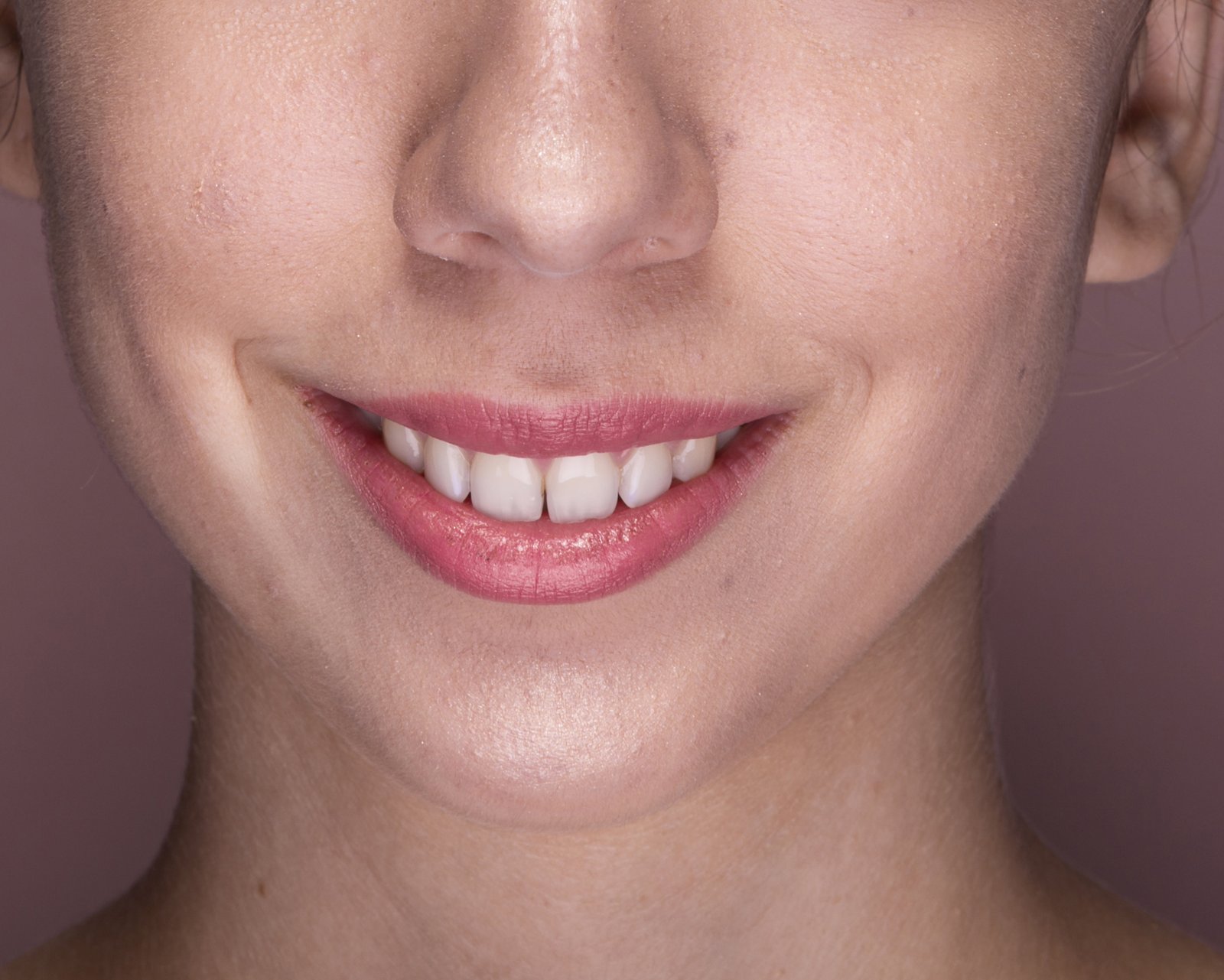
People with this type of lower jaw usually enjoy a happy and healthy old age. They are physically robust, have filial children and grandchildren, and are surrounded by friends and subordinates who support them. The wealth and blessings they accumulated in their youth allow them to enjoy a secure and peaceful old age, with a rich and tranquil spiritual world. Their lives are like rivers flowing into the sea; though lacking the dramatic ups and downs of middle age, they possess a deeper and broader serenity.
Conversely, if the lower part of the face appears pointed or too short, or if the mouth is small and the lips thin, and the philtrum is flat and full, it indicates that one’s fortune in old age may be rather lonely and unstable. This may manifest as poor health, a weak bond with one’s children, or difficulty in maintaining achievements in old age, even if one has made them in their youth. This reminds us that life requires not only knowing how to strive and struggle, but also learning how to protect and manage, laying a solid foundation for one’s later years. The mouth has more readings than size alone, and our guide to lip shapes in face reading covers lip thickness, balance, the corners of the mouth and the lines around it.
The Five Sacred Mountains of the Face and Your Life Path
Having grasped the macro framework of the “Three Courts” of the face, we also need to delve into the “Five Sacred Mountains” of the face, which are key to determining a person’s social status and life trajectory. The “Five Sacred Mountains” are centered on Mount Song (nose), forming a protective archway with Mount Heng (forehead), Mount Heng (chin), Mount Tai (left cheekbone), and Mount Hua (right cheekbone). The phrase “Five Sacred Mountains paying homage” refers to these five areas being full and rounded, echoing each other, creating a noble and stable aura.
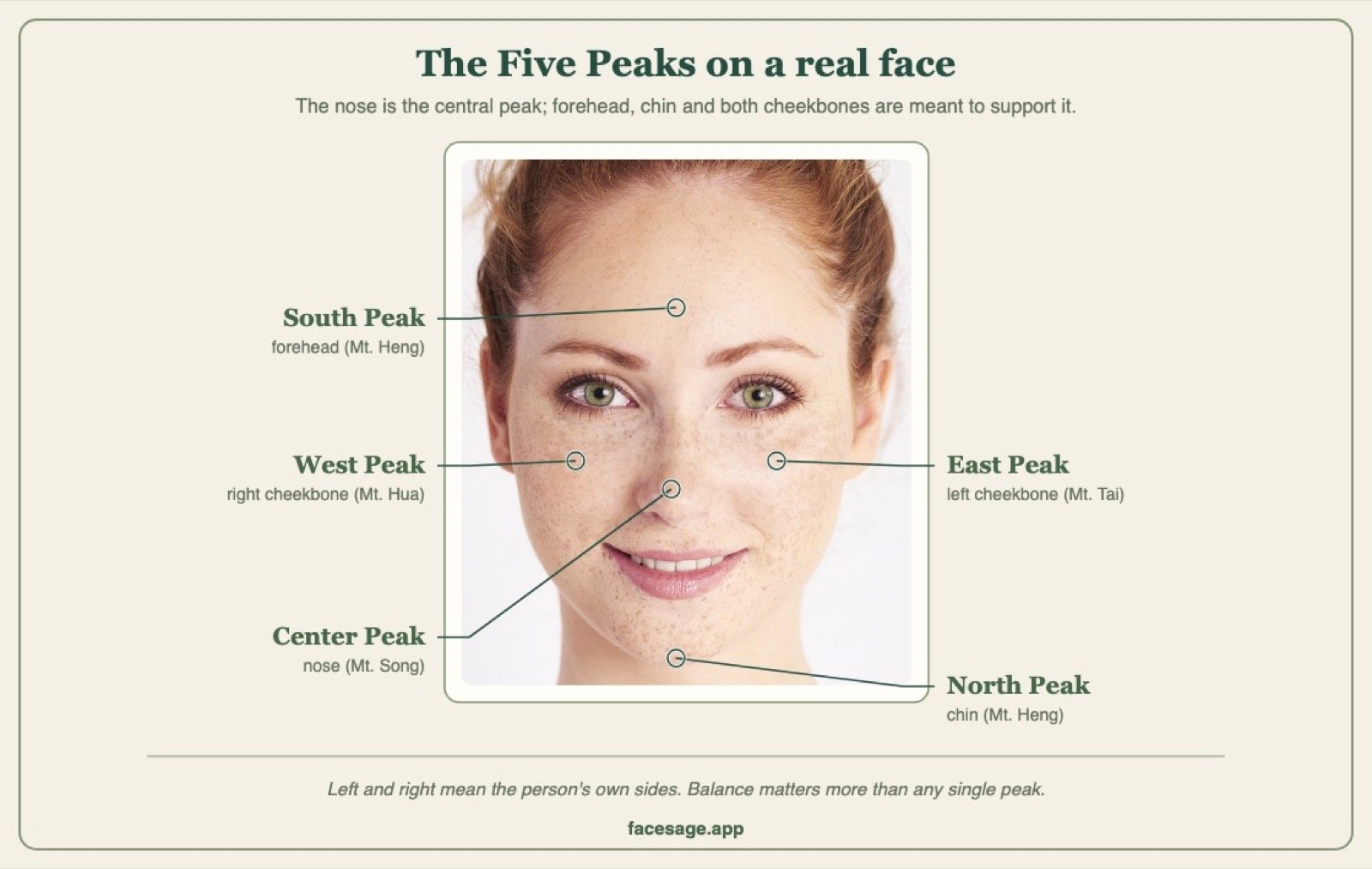
The Nose (Mount Song): Wealth and Self
In physiognomy, the nose is known as the “Palace of Wealth” and the “Official of Judgment.” Located in the very center of the face, it is considered the master of the five sacred mountains, and its importance is self-evident. A person’s self-esteem, self-confidence, willpower, and most importantly, wealth, are all reflected in their nose.
An excellent nose should have a straight bridge, a high root (between the eyes), a round and fleshy tip (called a “hanging gall bladder nose” in physiognomy), and full nostrils that do not show. Such a nose symbolizes a strong inner self, unwavering will, decisiveness, and exceptional financial and wealth-accumulating abilities. Such individuals are destined for wealth throughout their lives, possess grand career ambitions, and are natural leaders and wealth creators.
A low, crooked nose, or a nose with a bump on the bridge, a pointed tip, or exposed nostrils is generally considered an unlucky sign. A low nose bridge indicates a lack of self-confidence and a tendency to follow the crowd; a crooked nose bridge suggests a dishonest nature and a life filled with ups and downs; a pointed, fleshless nose tip indicates a harsh and demanding personality and poor financial luck; and exposed nostrils are like a hole in a money bag, a classic sign of “leaky wealth,” meaning that even if someone can earn money, they will find it difficult to keep it. Our guide to nose shape and personality goes further, covering the root, bridge, tip, wings and nostrils one by one.
The Forehead (Mount Heng): Career and Future Prospects
The forehead, located in the “Palace of Official Career,” is the Southern Peak among the Five Sacred Mountains, representing a person’s career prospects, social status, and wisdom. It should be high, broad, flat, and bright, like a wide platform, to support a promising future.
A full, smooth forehead symbolizes a person with quick thinking, foresight, strong early fortune, academic success, and the ability to be promoted by elders and superiors in their career. They often occupy high positions in their official careers or workplaces, gaining fame and respect.
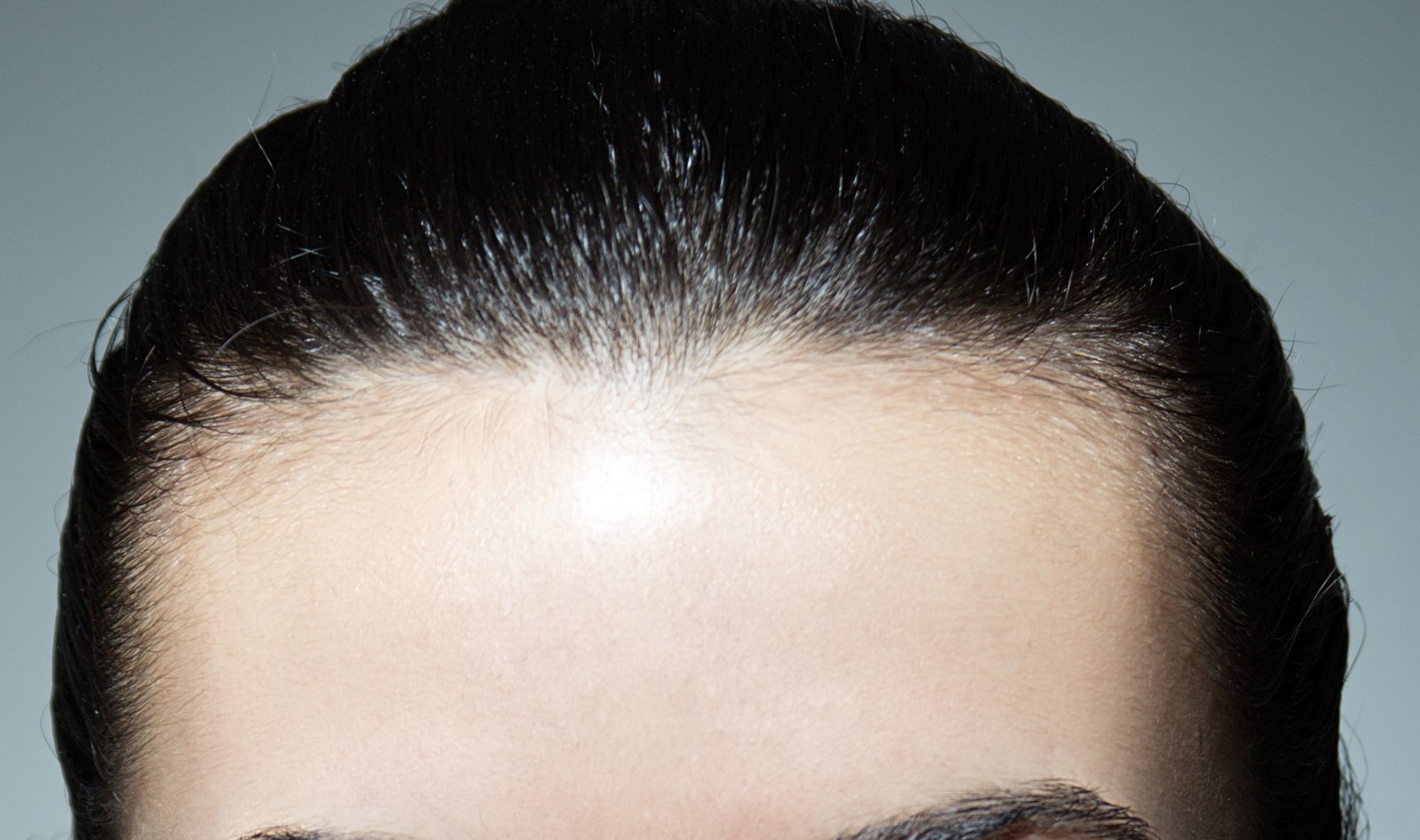
If a person has a narrow, sunken forehead, or is covered with messy lines and scars, it signifies that their career path will be fraught with obstacles. Such individuals may lack thorough consideration and a strategic perspective at work, or they may experience bad luck, frequently missing opportunities. Their career development will require more hard work and patience. For more detail, see our guides to forehead shapes and their meaning and hairline height and shape, since the hairline sets the upper edge of the forehead.
The Chin (Mount Heng): Later Life and Foundation
The chin, also known as the “Earthly Pavilion,” is the northernmost of the Five Sacred Mountains, representing a person’s fortune in old age, real estate, subordinates, and perseverance. A good chin should be broad, full, and slightly forward-pointing, which is called “a square and round Earthly Pavilion.”
People with this type of chin are steady, reliable, and possess exceptional patience and perseverance. The achievements they build in their youth are firmly passed down to them in their later years. They enjoy stable family lives, have the support of subordinates and younger generations, and live a blessed and comfortable old age with both happiness and longevity.
People with pointed, receding, or excessively short chins may have weak willpower and be prone to starting things but not finishing them. Their later years may lack stability, or they may experience many troubles related to their home or subordinates. Such individuals especially need to cultivate patience and composure to prepare adequately for their later years. Our guide to chin and jaw face reading looks at pointed, square, round and double chins, and why proportion is checked first.
The Cheekbones (Mounts Tai and Hua): Power and Connections
The cheekbones on both sides, representing the eastern and western peaks respectively, are symbols of power and also indicate a person’s interpersonal relationships and drive. Ideally, the cheekbones should be full and fleshy, of moderate height, and form a protective arch with the nose.
People with prominent cheekbones are usually courageous and decisive, with strong execution skills. They can establish prestige within a team and gain the support and endorsement of others. They are good at socializing and have a wide network of connections, allowing them to navigate both official and business circles with ease and wield real power.
However, higher cheekbones are not necessarily better. If cheekbones are too high while the nose is low, this is called “a solitary peak,” indicating that the person, though power-hungry, is mean-spirited, stubborn, and prone to conflict, ultimately alienating others. On the other hand, those with low cheekbones or no cheekbones lack ambition and management skills, are unsuitable for leadership, and will spend their lives toiling for others. Our guide to high and low cheekbones explains why the flesh covering the bone matters as much as its height.
The Twelve Palaces of the Face Reading Chart
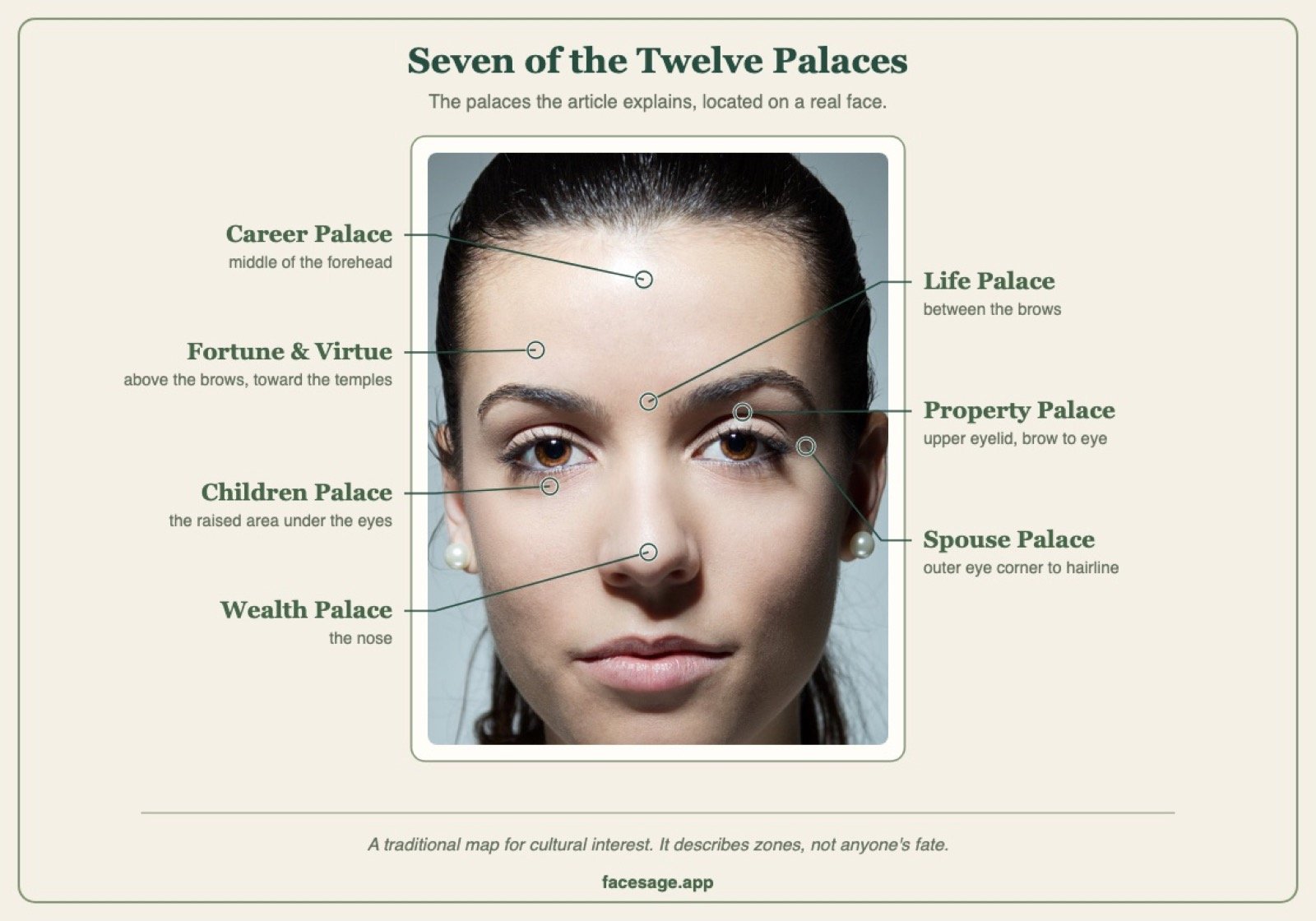
If the “Three Courts” and “Five Peaks” are the skeleton of life, then the “Twelve Palaces” of face reading are the flesh and blood that fill it. They meticulously divide all aspects of our lives, such as career, wealth, marriage, children, and health, and correspond them to specific areas of the face. By observing the shape and complexion of these “palaces,” one can gain insight into the subtle changes in the myriad aspects of life. Some palaces come in pairs, such as the Spouse Palace beside each eye, and our guide to the left and right sides of the face explains when the “left for men, right for women” rule applies and why both sides should be read together.
The Life Palace (Between the Brows): Your Destiny
The area between the eyebrows, known as the “Hall of Destiny,” is the most important of the twelve palaces. It is the gathering place of a person’s essence, energy, and spirit, and also the master switch for overall fortune. The Hall of Destiny should ideally be open, flat, and smooth, with a width that can accommodate one and a half to two fingers.
A person with a broad and bright Life Palace (or Destiny Palace) is broad-minded, optimistic, and enjoys a smooth life with many helpful people around them. Even when facing difficulties, they can turn misfortune into good fortune. Conversely, a narrow Life Palace, or the presence of a vertical line (like a hanging needle line), a mole, a scar, or connected eyebrows, indicates a person with a heavy heart, more worries than joys, an impatient nature, and a tendency to encounter obstacles and unexpected events in life. A “dark forehead” refers to a dull complexion in this area, a clear sign of low luck, requiring extra caution in all actions.
The Spouse Palace: Marriage and Emotional Life
The area between the outer corner of the eye and the hairline is called the “marital palace” or “marriage palace.” This area governs the quality of a person’s marriage and emotional life. This area should ideally be full, smooth, and glossy.

People with a full and radiant marital palace (the area around the spouse’s palace) usually have a harmonious and happy marriage, with a deep affection and mutual support between their partners. However, if this area is sunken, scarred, has messy “crow’s feet” wrinkles, or has a dull complexion, it may be a sign of marital discord. This could indicate a turbulent emotional life, frequent arguments, or even the pain of divorce or widowhood.
The Children Palace (Under the Eyes): Your Descendants
The raised area below the eyes, known as the “silkworm” area, is called the “children’s palace” or “tear trough.” It not only relates to the number and quality of children but also reflects the depth of the bond with them. This area should be full and bright, not sunken or dark.
People with full and shiny under-eye bags are usually energetic, charming, and have good relationships with their children, who are likely to be successful and filial. On the other hand, sunken or dry under-eye bags, or those with moles or messy lines, may indicate difficulties in fertility, worry and exhaustion about their children, and a more distant parent-child relationship.
The Wealth Palace (Nose): Lifelong Wealth
The nose, as the “Palace of Wealth,” has already been discussed in detail in the previous section on the “Five Sacred Mountains.” Here, we need to add the element of “complexion.” A person’s fortune is not only determined by the shape of their nose, but also by their complexion. When wealth is abundant, the entire tip of the nose will appear yellowish and bright, almost glossy. If the tip of the nose appears reddish, it indicates a risk of financial loss; if it appears dark and bluish-black, it may foreshadow significant financial loss or illness.
The Property Palace (Upper Eyelid): Family and Home
The upper eyelid, located between the eyebrows and the eyes, is called the “Field and House Palace.” It represents a person’s family property, real estate fortune, and the stability of their family environment. This area should ideally be broad, full, and clean.
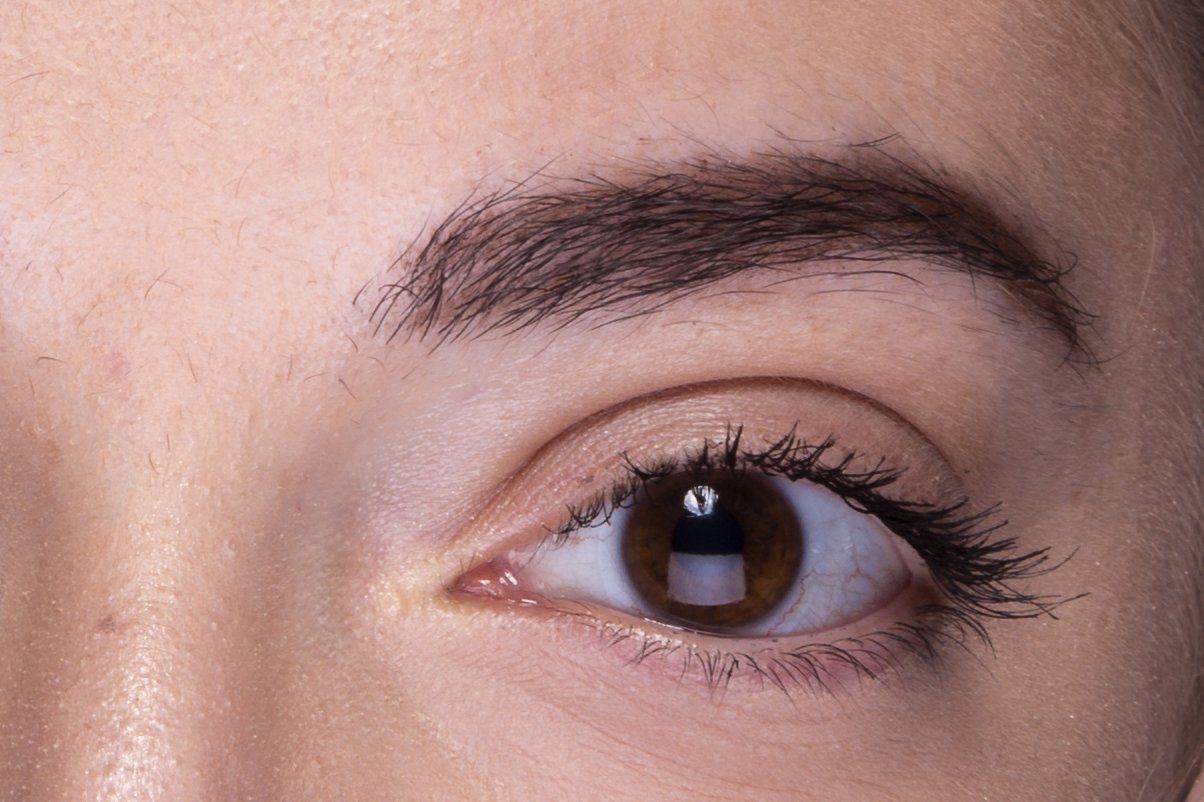
People with a broad and full “Property Palace” (tianzhai-gong) usually have strong family values and are able to inherit family property or purchase real estate through their own efforts, enjoying a stable and comfortable living environment. On the other hand, a narrow, sunken “Property Palace,” or the presence of moles or scars, may indicate an unstable family foundation, frequent changes in living environment, or difficulty in owning permanent property.
The Fortune Palace (Temples): Innate Blessings
The area above the eyebrows, at the temples, is known as the “Heavenly Granary” and is the location of the “Palace of Fortune and Virtue.” It represents a person’s innate blessings, ancestral virtues, and spiritual enjoyment. This area should ideally be flat, full, and broad.
People with full and broad temples in their foreheads tend to have a life of good fortune and few misfortunes, a peaceful mindset, and are blessed by their ancestors, leading to a rich spiritual life. On the other hand, sunken or narrow temples may indicate a life of hard work and little inner peace, requiring them to make up for their lack of innate blessings through good deeds and virtuous actions.
Final Thoughts: Your Face Reflects Your Heart
The study of physiognomy is profound and complex, far beyond what can be fully encompassed in a single text. What we observe is not merely the static form of the facial features, but more importantly, the flowing “complexion” and “spirit.” Form is the “hardware,” the innate foundation; while complexion and spirit are the “software,” the manifestation of acquired thoughts and behaviors, constantly changing and influencing our destiny. The same idea runs through our guide to what your ears say, which treats the spirit of the ears as more telling than their size.
“Fate is determined by heaven, but destiny is created by oneself.” Our facial features are both a summary of our past life experiences and a harbinger of our future. Like a mirror, they honestly reflect our inner world. A kind-hearted and positive person will gradually have more relaxed eyebrows and eyes, clearer eyes, and a radiant and peaceful complexion. This is the undeniable truth that “appearance reflects the heart.”

Therefore, instead of dwelling on the shortcomings of a particular part of your being, start cultivating your heart from this moment on. Be more tolerant, less calculating; more grateful, less complaining; more smiling, less sorrowful. When the sunshine shines from your heart, your face will naturally become kind and benevolent, radiating good fortune. This is the most precious lesson physiognomy teaches us, the ultimate wisdom capable of changing your life. Remember, your best feng shui is yourself.
Keep reading
What Is Face Reading and What Can It Tell You?
What Is Face Reading (Physiognomy)? Physiognomy is a folk art of fortune-telling that involves observing a person’s facial features, and strictly speaking,…
28 Eyebrow Types and Their Meaning in Face Reading
Eyebrows are one of the five facial features, and they have a certain influence on a person’s appearance and facial features. Below,…