
Why Beauty and Good Fortune Aren’t the Same in Face Reading
When many people think of “blessed women,” the first image that comes to mind is often a beautiful woman with delicate features, flawless skin, eyebrows like distant mountains, and eyes like autumn water. It seems that in most people’s minds, good looks equate to good fortune, a good marriage, and a good life. However, if you delve into ancient texts on physiognomy, from *Ma Yi Shen Xiang* to *Liu Zhuang Xiang Fa*, from *Shen Xiang Quan Bian* to *Bing Jian*, you’ll discover a surprising truth, the true blessed appearance in the eyes of the ancients is almost entirely different from our modern standards of beauty. Those faces we praise as having “clear eyebrows and bright eyes” may not necessarily be considered blessed by physiognomists; those we admire for their “fair skin and beautiful features” may not be able to bear the weight of good fortune in terms of destiny. The truly blessed appearance is hidden in details you may never have noticed, and these details are precisely what many people overlook throughout their lives. For a feature-by-feature self-check based on the same tradition, our Mian Xiang self-assessment guide covers the forehead, eyes, nose, mouth and ears.
I’ve seen too many cases like this. A friend’s older sister was a renowned beauty in her youth, famous throughout the surrounding area. With willow-leaf eyebrows, phoenix eyes, an oval face, and radiant white skin, she had suitors lining up. Everyone said she was lucky, destined to marry well and enjoy a lifetime of happiness. But what happened? She married a seemingly well-off husband, but her marriage was fraught with hardship. Her husband’s business failed, her relationship with her mother-in-law was strained, and her children were sickly. By her forties, she was haggard and her former beauty had vanished. In contrast, one of her classmates was plain-looking, even somewhat “rustic” by conventional standards, a round face, a slightly large nose, thick earlobes, and a broad chin. In her youth, no one praised her beauty, and she had few suitors. But she married a hardworking and reliable husband, had a harmonious family, and two children. Now in her fifties, she’s thriving, with a rosy complexion and an air of serene contentment. Such contrasts are commonplace in life. This is not an isolated case, but a pattern that has been repeatedly confirmed in physiognomy.
What Does Fu, or Good Fortune, Mean in Face Reading?
To understand this pattern, we must first clarify a fundamental question: what exactly does “fortune” (fu, meaning good fortune) refer to in physiognomy? Is it the same as the “blessedness” (fuqi, meaning good fortune) we usually understand?
In traditional Chinese culture, “fortune” (fu, meaning fortune or blessing) is a concept with extremely rich connotations. It doesn’t just refer to material wealth, nor is it simply about marrying a rich husband. The ancients spoke of the “Five Blessings”longevity, wealth, health and peace, virtuous conduct, and a peaceful death, encompassing these five dimensions. A truly blessed person is one who achieves fulfillment in all five aspects. And what physiognomy observes is precisely a person’s overall fortune and capacity to bear these burdens.

Pay attention to these last four words, “bearing capacity.” This is the key to understanding a blessed appearance. Physiognomy believes that good fortune is not a gift that falls from the sky, but rather an energy that a person’s mind and body can “receive,” “bear,” and “digest.” Just like a cup, a large cup can hold more water, while a small cup will overflow even when full. A person’s facial features reflect the size and quality of this “container.”
From this perspective, it’s easy to understand why “delicate eyebrows and bright eyes” don’t necessarily equate to a blessed appearance. Delicate eyebrows and bright eyes reflect the refined and delicate features of a person, falling under the category of “refined elegance.” Refined elegance signifies intelligence, agility, and talent, but it doesn’t inherently imply “depth.” In physiognomy, however, good fortune is closely linked to “depth.” Physiognomy embodies the virtue of carrying great responsibility, the power of accumulating knowledge and experience, depth, and richness, all these terms related to good fortune are inseparable from this concept of “depth.” A person with overly delicate and refined features is like a fine porcelain cup; it may be beautiful, but its capacity is limited, and it cannot withstand significant damage.
Similarly, why doesn’t “fair skin and beauty” necessarily bring good fortune? Because in physiognomy, fair skin and a beautiful face correspond more to “peach blossom luck” (romantic luck) than “good fortune and prosperity.” People with abundant peach blossom luck are popular with the opposite sex and attract attention, but peach blossom luck is a double-edged sword, while it brings attention and opportunities, it can also bring trouble and controversy. Throughout history, among women renowned for their beauty, from Xi Shi to Yang Guifei, from Chen Yuanyuan to Sai Jinhua, which one could be considered “blessed”? Their beauty brought them more hardship and a lack of control over their lives.
What Classic Chinese Face Reading Texts Say About Women
Ancient physiognomists, after observing the correspondence between the facial features and destinies of countless people, summarized a complete system of auspicious facial features for women. This system differs greatly from today’s aesthetic standards, but its accuracy has been astonishing after thousands of years of verification.
The book “Ma Yi Shen Xiang” contains this passage: “For a woman, wealth and nobility lie in a substantial and dignified appearance, and good fortune lies in a broad and round face. A face like a full moon will ensure a life free from worries about food and clothing; a nose like a hanging gall bladder will bring honor to her husband and noble children, and she will have someone to rely on.” This highlights two core characteristics of a blessed appearance: substantiality and a broad and round face.

The book “Liu Zhuang’s Physiognomy” also contains a similar statement: “The method of judging a woman’s character is to first observe her spirit, then examine her bones, and finally look at her flesh. A calm spirit indicates nobility, upright bones indicate longevity, and abundant flesh indicates good fortune. When all three are present, it is a sign of great fortune and nobility.” This passage more clearly points out that “abundant flesh”that is, a full and plump face, is the direct manifestation of good fortune.
However, it’s crucial to emphasize that the “fullness” and “substance” in physiognomy are not simply about being “fat.” A person can be very fat but lack any sense of fortune in their appearance because that kind of puffy, swollen flesh lacks substance, luster, and elasticity. In physiognomy, this is called “dead flesh,” which is considered an unlucky sign. True auspicious fullness is characterized by firm, smooth, plump, elastic, and lustrous skin, a plumpness like a ripe fruit brimming with vitality, radiating a harmonious and fulfilling aura from within.
Which Facial Features Signal Good Fortune in Women?
So, specifically, what facial features truly indicate good fortune? This requires a detailed explanation, from the overall appearance to the details.
Overall Demeanor
First, let’s talk about overall demeanor. A truly blessed woman gives the first impression of being “stable” and “harmonious.” Stability refers to her calm and composed aura, neither frivolous nor impatient. When she sits there, she’s like a small hill, quiet and serene, yet inspiring a sense of security and reliability. Harmony refers to the peaceful and gentle nature of her facial expressions and overall demeanor, devoid of hostility or sharpness, making her appear comfortable and approachable. In physiognomy, this quality is called “tranquility” and “harmony,” fundamental conditions for the accumulation of good fortune. If a person is constantly restless, frowning, and carrying a hostile expression, her good fortune will leak away like water.

Face Shape
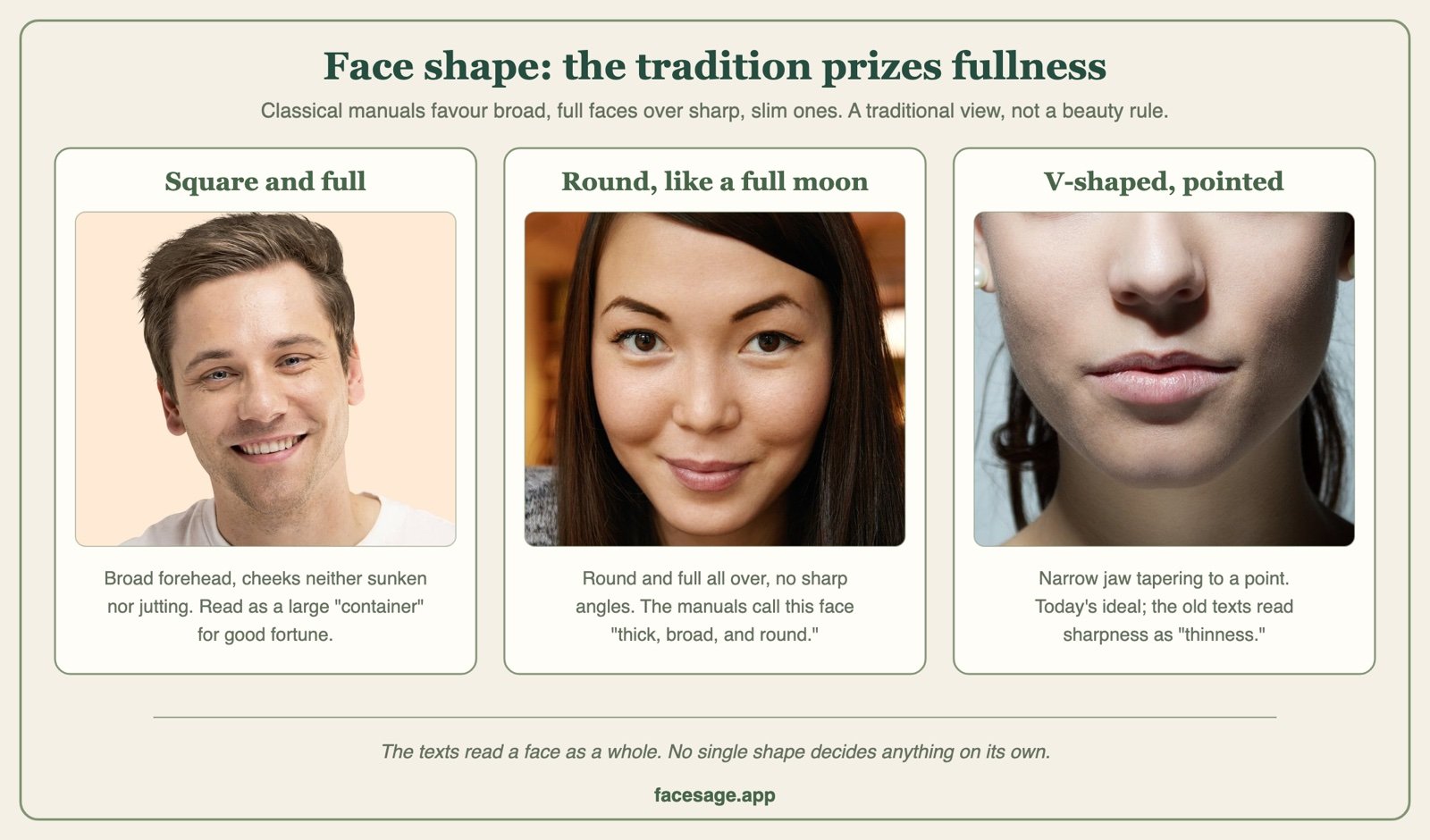
Secondly, let’s talk about face shape. Ancient physiognomy roughly categorizes human face shapes into several types: square face, tian face, jia face, shen face, you face, etc. Among these face shapes, the tian face and the face close to the round face are considered the most auspicious. The tian face is characterized by a square and full shape, a broad forehead, cheekbones that are neither prominent nor sunken, and fleshy but not protruding cheeks; the entire face looks like a full square. The round face, on the other hand, is round and full in all areas, without any sharp angles, resembling a full moon. Both of these face shapes meet the auspicious standard of “thick, broad, and round,” because they represent a sufficiently large “container” to hold good fortune.
Conversely, overly sharp face shapes, such as V-shaped or oval faces, while highly sought after in today’s aesthetics, are considered unlucky in face reading. This is because sharpness implies thinness, and thinness cannot support thickness. Many modern women undergo bone reduction surgery and Botox injections to achieve a smaller face, which, from a face reading perspective, actually diminishes their own fortune. Of course, this doesn’t mean that women with oval faces are necessarily unlucky; face reading should be considered holistically, not based on a single aspect. But specifically regarding face shape, a full, wide, and rounded face is indeed superior to a sharp, slender one.
The Forehead
Let’s talk about the forehead. In physiognomy, the forehead is called the “Heavenly Court,” representing a person’s early fortune and overall wisdom. A woman with a blessed forehead has several characteristics: First, it’s broad, the forehead isn’t narrow horizontally, occupying at least two-thirds of the face’s width; second, it’s full, the forehead isn’t flat or sunken, but rather slightly protrudes forward, like a full drumhead; third, it’s smooth, the skin on the forehead is delicate and smooth, without many blemishes or scars. A forehead that meets all three conditions is called a “full Heavenly Court,” considered a sign of great fortune in all physiognomy books.
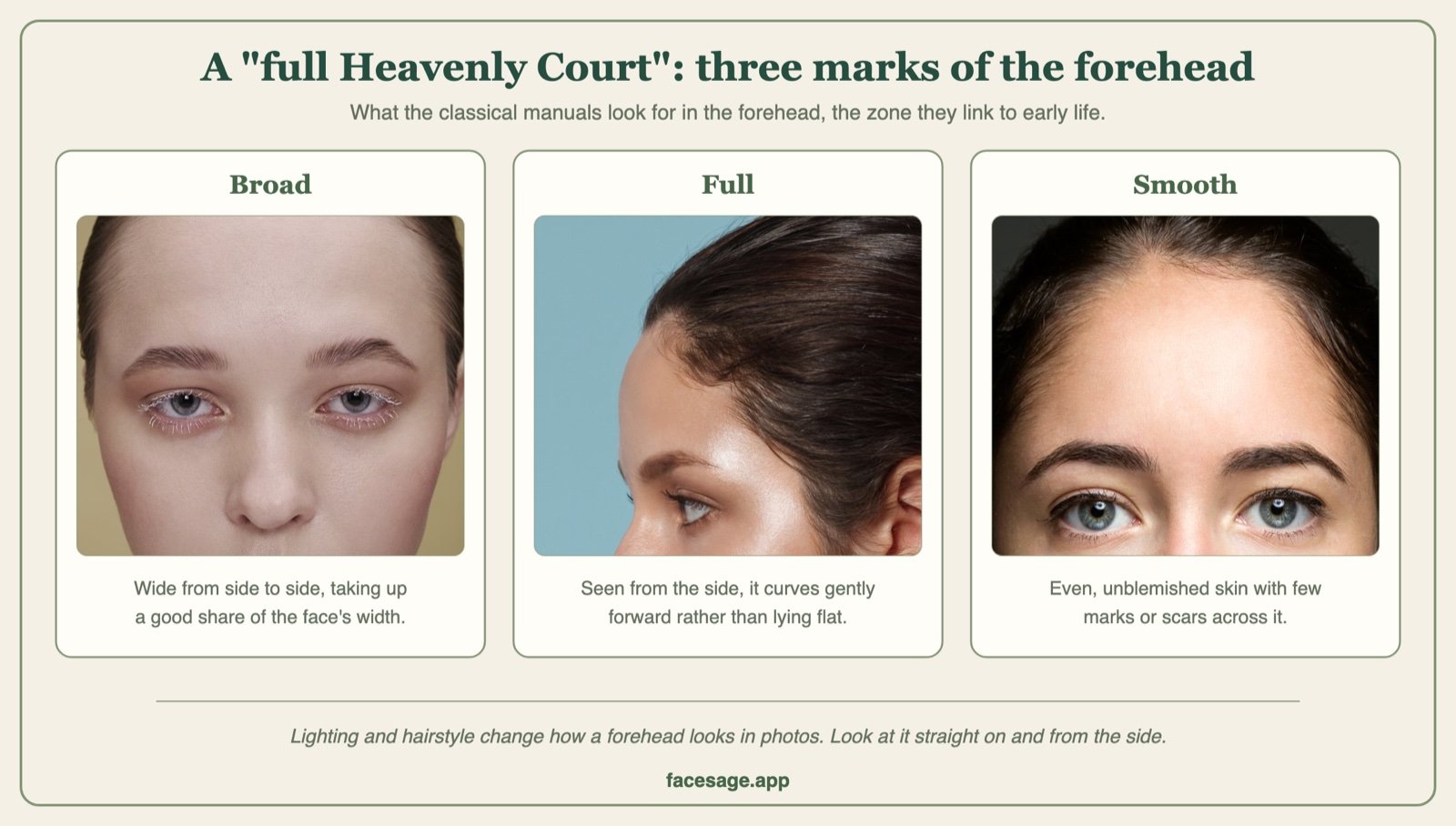
A woman with a full forehead signifies three things: First, she enjoys a smooth early life, growing up in a favorable environment, receiving a good education, and developing a sound personality. Second, she possesses sufficient wisdom and foresight to manage her life, avoiding short-sighted and foolish choices. Third, she is fortunate to have benefactors, easily receiving protection and support from elders and superiors. These three factors combined form a solid foundation for a woman’s lifelong good fortune.
The Eyebrows
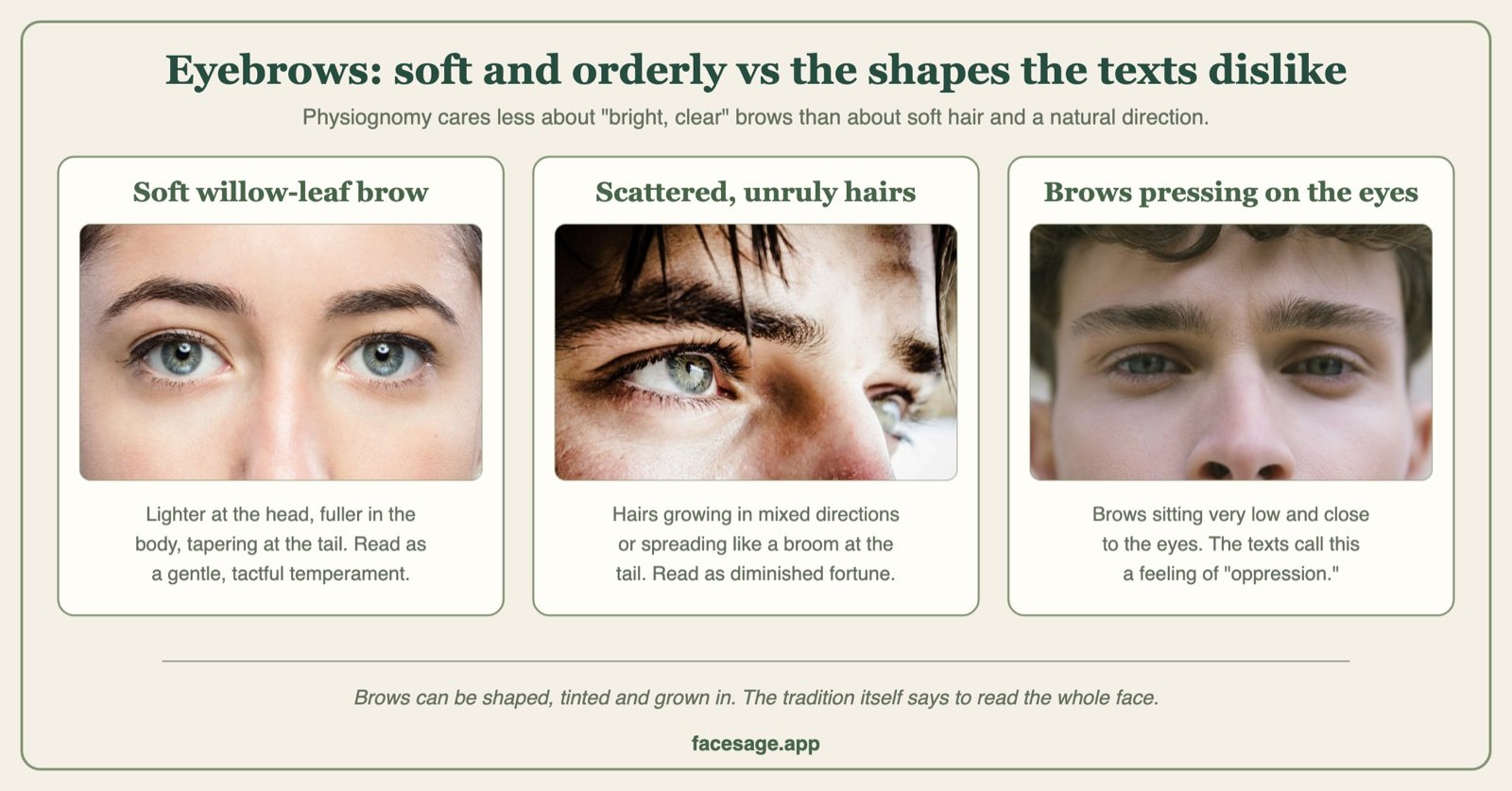
Then let’s talk about eyebrows. Many people believe that “clear and bright eyebrows” equate to a good face, but in the standards of auspiciousness, the key to eyebrows isn’t “clear and bright,” but rather “softness” and “strength.” What does this mean? It means that eyebrow hairs should be soft and smooth, not coarse, stiff, or messy; at the same time, the eyebrow shape should have a natural curve and direction, not be scattered and disordered. The most auspicious eyebrow shape is one where the inner corner is slightly lighter, the body gradually darkens, and the tail slightly tapers, like a soft willow leaf naturally resting above the eye. This eyebrow shape represents a gentle temperament, a kind heart, and a tactful and appropriate way of dealing with people.
In physiognomy, there are several eyebrow shapes that are particularly considered unfavorable: eyebrows growing in the opposite direction (hair direction is inconsistent), eyebrows with a break in the middle (a noticeable gap in the middle of the eyebrow), eyebrows with scattered ends (eyebrows that spread out like a broom at the end), and eyebrows that press down on the eyes (eyebrows that are too close to the eyes, creating a strong sense of oppression). In physiognomy, these eyebrow shapes are all considered symbols of diminished fortune, corresponding to unfavorable factors such as a violent temperament, life’s ups and downs, loneliness in old age, and a narrow-mindedness.
The Eyes, Nose and Mouth
The Eyes
Next is the eyes. There’s a significant difference between the standards of good fortune and beauty when it comes to eyes. In today’s aesthetics, people prefer large eyes, double eyelids, and upturned phoenix eyes or peach blossom eyes. However, in the standards of good fortune in physiognomy, the most auspicious eyes aren’t necessarily large, and may even be slightly small, but they must possess a core characteristic, “a focused spirit.”
What does it mean to have a focused and meaningful gaze? It means that your eyes have light, stability, and depth. When you look into her eyes, they are not empty or blank, nor are they shifty or sharp; rather, they are warm, restrained, deep, and serene. This kind of gaze is like a deep pool of water, seemingly calm on the surface, but you can feel the abundant energy contained beneath. A woman with this kind of gaze has a rich and stable inner world, not easily swayed by external storms, and able to maintain her composure and calmness in any situation.
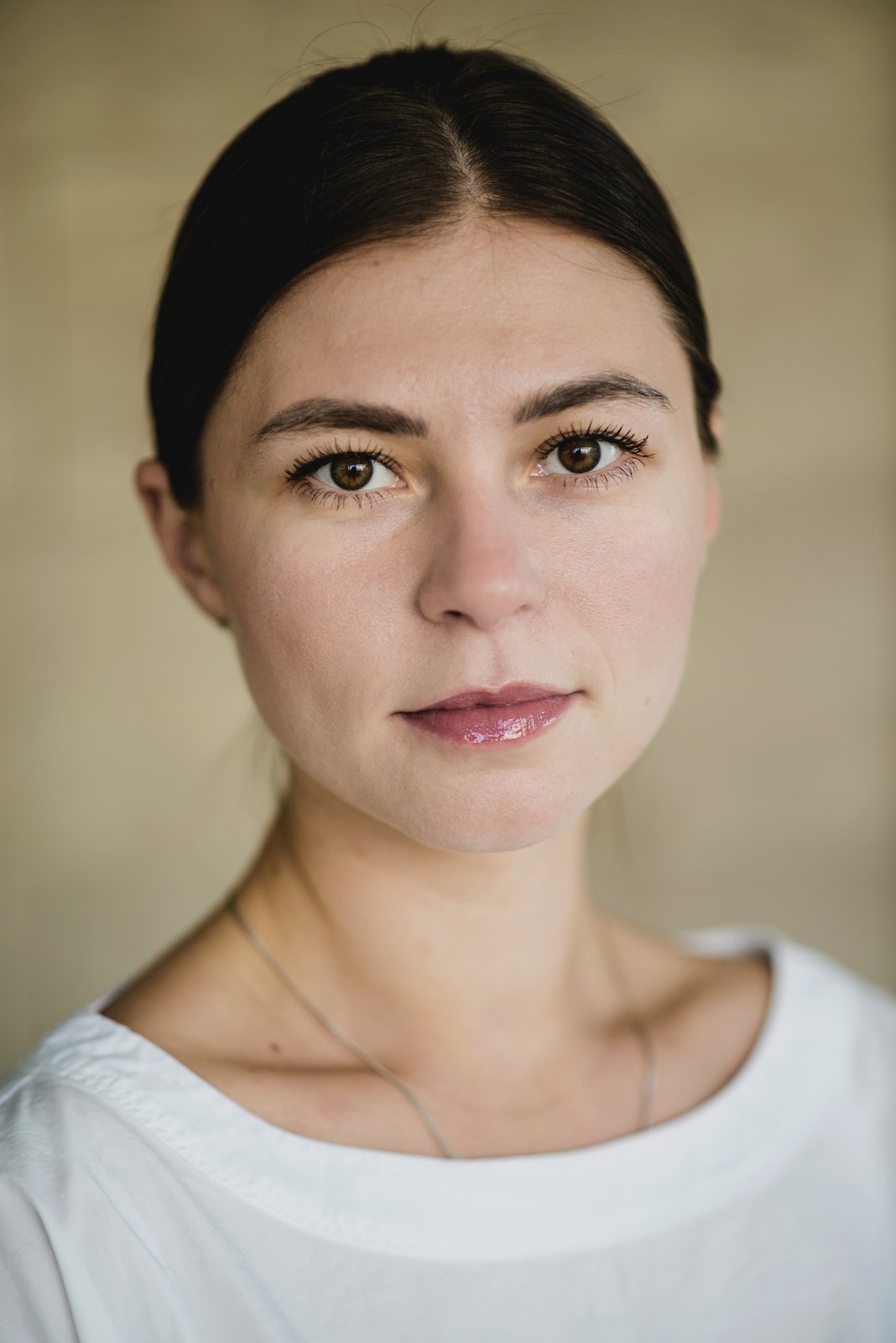
In physiognomy, there’s a saying called “eyes radiating good fortune.” This good fortune isn’t the aggressive, piercing kind, nor is it the frivolous, flirtatious kind; rather, it’s a warm, gentle, and benevolent light. When you see this kind of gaze, you’ll instinctively want to be close to the person, feeling comfortable and at ease in their presence. The essence of this gaze is actually the outward manifestation of a person’s inner kindness, peace, and contentment. A person filled with resentment, anxiety, and dissatisfaction, no matter how beautiful their features, will not have this kind of light in their eyes.
The Nose
Then we come to one of the most crucial parts of the face, the nose. In a woman’s face, the importance of the nose cannot be overstated. Physiognomy refers to the nose as the “Palace of Wealth” and also the location of the “Husband Star.” A woman’s nose directly relates to her lifelong fortune and the quality of her marriage.
What are the characteristics of a woman’s nose if she is blessed with good fortune? First, the bridge of her nose is straight but not pointed. Note the word “but”a straight bridge is good, indicating assertiveness and integrity; however, if it is too pointed, like a sharp blade, it is considered an unlucky sign. The best nose is straight with a slight roundness, standing gently in the center of the face like a piece of smooth jade. Second, the tip of the nose is full and round. This is extremely important. In physiognomy, the tip of the nose represents a person’s wealth and fortune. A woman with a full, round, and fleshy nose tip will never worry about money and will spend it wisely and be good at saving. Conversely, a woman with a pointed and thin nose tip often finds it difficult to accumulate wealth. Third, the alae are full. The alae are the sides of the nose. Full alae represent strong ability to retain wealth and a stable life. If the alae are too thin, or if the nostrils are visible from the front (commonly known as a “turned-up nose”), it indicates a tendency to lose money and not be able to keep it.
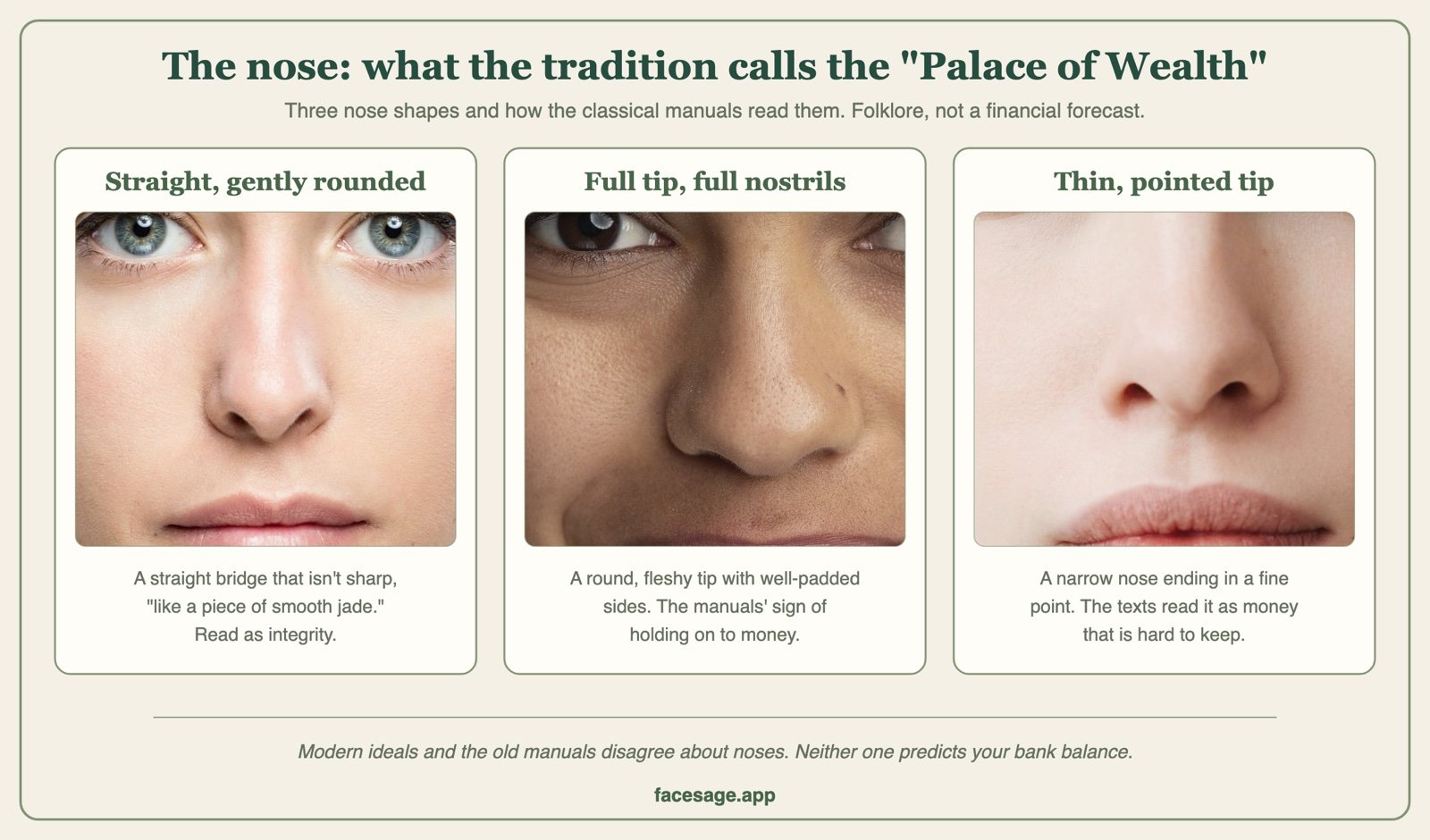
Many young women pursue the European-style high, straight nose with a pointed tip, even resorting to plastic surgery. Little do they know that in the system of physiognomy, this type of nose is actually a sign of poor fortune. Of course, we cannot deny modern aesthetics because of this; each era has its own standards. But if you want to understand good fortune from a physiognomy perspective, then a “garlic nose” with a full, rounded tip and plump alae is actually much more auspicious than a high, pointed “beauty nose.”
The Mouth and Lips
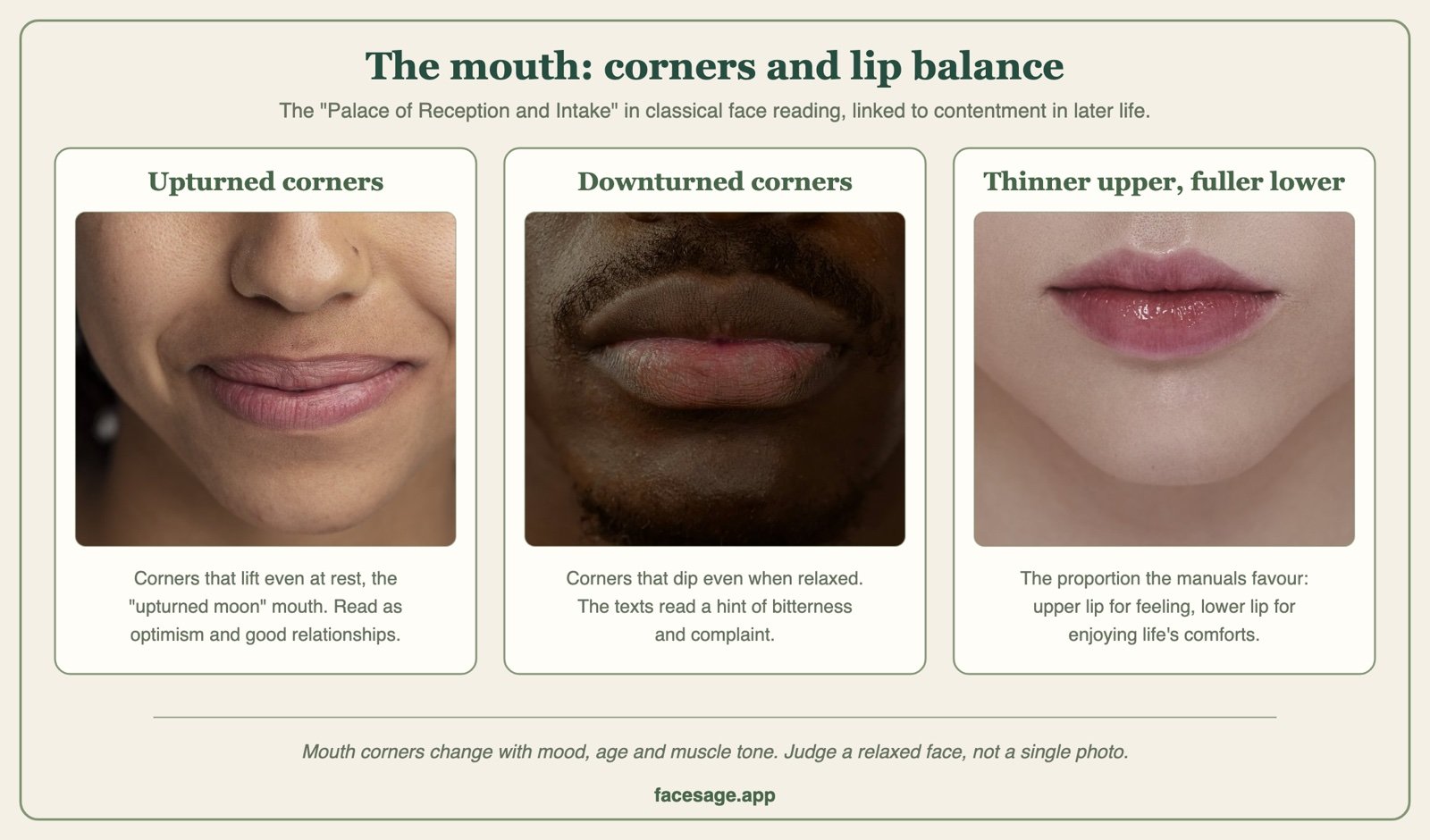
Having discussed the nose, let’s talk about the mouth. In physiognomy, the mouth is called the “Palace of Reception and Intake,” which not only relates to a person’s eloquence and expression abilities but also closely relates to their fortune in old age and the enjoyment they receive from food. The characteristics of a blessed woman’s mouth are: lips of moderate thickness, clear contours, slightly upturned corners, and neat, white teeth.
The direction of the corners of the mouth is particularly crucial. A person with naturally upturned corners of the mouth appears to be smiling even when not actually smiling; in physiognomy, this is called an “upturned moon mouth” or a “bow mouth,” considered a sign of great fortune. This is because upturned corners of the mouth represent an optimistic and open-minded attitude, good interpersonal relationships, and a prosperous old age. Conversely, a person with downturned corners of the mouth, even when smiling, carries a hint of bitterness; this facial feature often corresponds to inner dissatisfaction, a complaining personality, and a regretful old age.
There’s a common misconception about lip thickness that needs clarification. Many people believe that thick lips indicate good fortune, while thin lips indicate a lack of affection. This isn’t entirely true. In physiognomy, the proportion and texture of the upper and lower lips are considered auspicious. The most fortunate lips are those with a slightly thinner upper lip and a slightly thicker lower lip. This is because the upper lip represents emotional expression, while the lower lip represents material enjoyment. A thicker lower lip indicates a person who can enjoy life, has good food, and a solid material foundation. Furthermore, the lips should be a vibrant, rosy color, not too pale or dull. Rosy lips represent abundant blood and vitality.
The Ears, Chin and Complexion
The Ears
Next, let’s talk about a feature that many people overlook but is extremely important in physiognomy, the ears. In physiognomy, the ears are called the “Palace of Hearing,” representing a person’s foundation, wisdom, and early life fortune. More importantly, the ears are the most resistant to change with age among the facial features, thus reflecting a person’s innate blessings.
A woman with good fortune has the following ear characteristics: First, her ears are generally large and thick. In physiognomy, large ears represent a generous spirit and a broad perspective, while thick ears represent a solid material foundation. Observe the wives of older generations of entrepreneurs and noblewomen; many of them have large and thick ears. Second, her earlobes are thick and full. This is one of the most well-known characteristics of good fortune; the saying “people with large earlobes are lucky” is almost common knowledge. In physiognomy, earlobes represent a person’s fortune in their later years and their ability to accumulate wealth. The thicker, larger, and fuller the earlobes, the more wealth a person can accumulate and the more comfortable their later years will be. Third, her ears are white and lustrous or slightly pink. If the color of the ears is whiter than the complexion, it is a sign of great nobility in physiognomy, indicating that this person has hidden nobility. Although they do not show off in ordinary times, they can always turn misfortune into good fortune and overcome difficulties in critical moments.
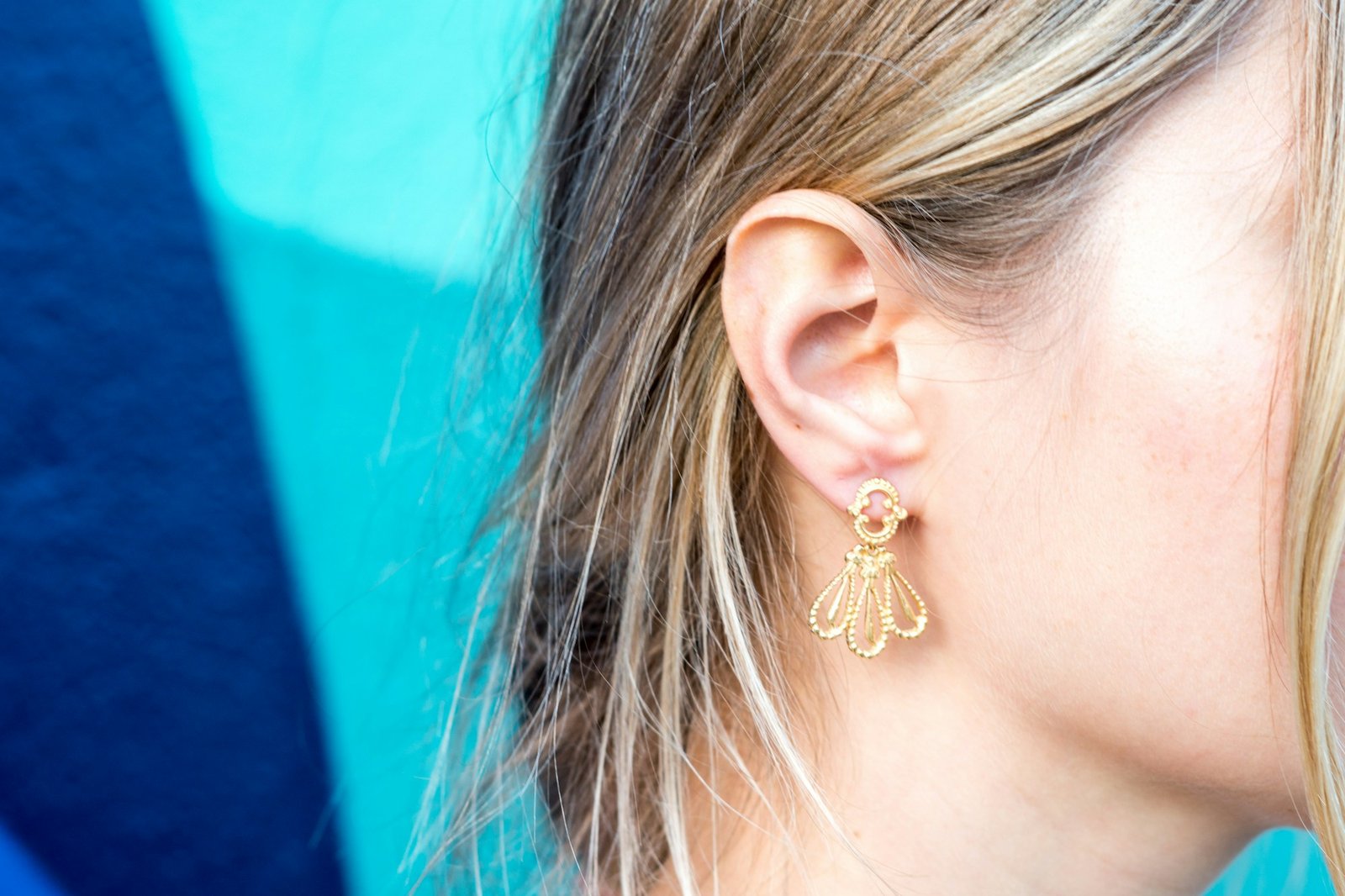
Conversely, ears that are as thin as paper, with almost no earlobes, and noticeably outward-turned rims are considered in physiognomy to indicate a lack of innate good fortune, requiring more effort to compensate later in life. Of course, this is not absolute; physiognomy is a comprehensive field of judgment, and one cannot negate a person’s entire fortune based on an undesirable feature.
The Chin
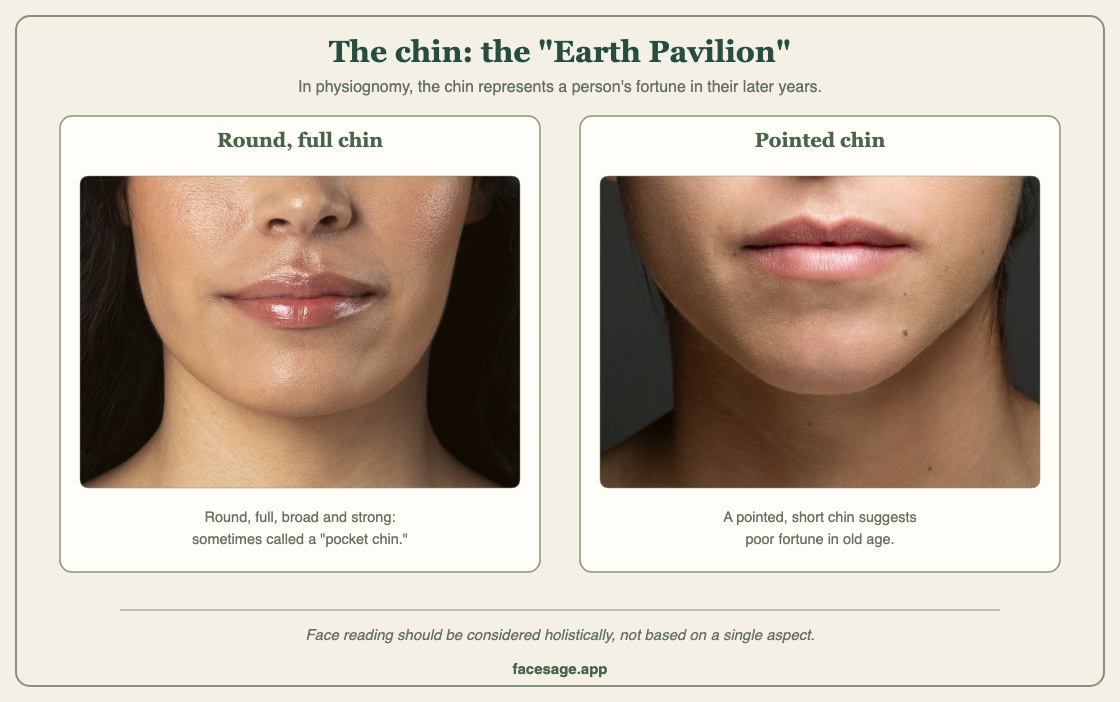
Let’s talk about another very important but often overlooked feature, the chin. In physiognomy, the chin is called the “Earth Pavilion,” representing a person’s fortune in their later years, their luck with servants (whether they can get support from subordinates and younger generations), and their family fortune. If the forehead (Heavenly Court) represents one’s early years, then the chin (Earth Pavilion) represents one’s later years; the two are complementary.
The most auspicious chin shape is round, full, slightly upturned, broad, and strong. This type of chin is sometimes called a “pocket chin”like a pocket, it can catch and hold all the good fortune flowing down from above, preventing it from flowing away. Women with this type of chin, no matter what ups and downs they experience in the first half of their lives, will surely enjoy peace and tranquility in their later years, surrounded by children and grandchildren, and free from worries about food and clothing.
Conversely, a pointed, short chin suggests poor fortune in old age and a potentially bleak later life. In particular, a chin that appears almost like a sharp angle when viewed from the front is considered in physiognomy to have a “beginning without an end” face, one may have a glorious first half of life, but is prone to decline in the second half, ending up lonely and isolated in old age. This is why many physiognomists emphasize the importance of the chin, as a person’s happiness in old age directly determines whether their life’s “end” is fulfilling.
Complexion
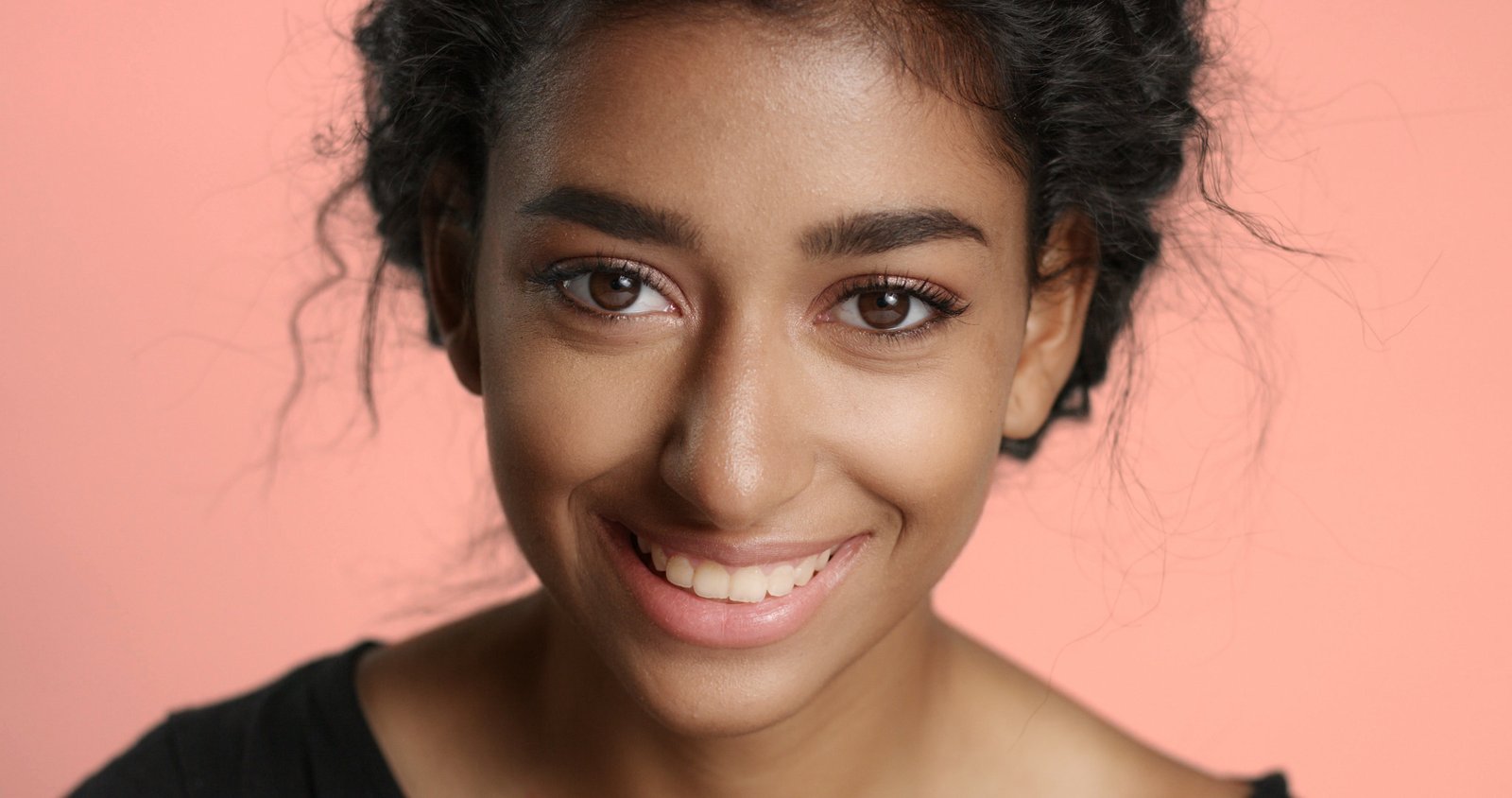
Having discussed facial features, there’s another crucial element often overlooked by laypeople, the overall “complexion” of the face. Physiognomy considers not only the “form” (shape and structure) but also the “color” (luster and radiance). Even someone with excellent facial features may have a dull and sluggish complexion, indicating a current downturn in fortune. Conversely, someone with average features but a bright, clear, and radiant complexion signifies good fortune and the accumulation of blessings.
What are the characteristics of a woman with good fortune? First, an even complexion. This doesn’t mean being pale, but rather that the skin tone across the entire face should be uniform, without large areas of dark spots, patches of discoloration, or shadows. An even complexion indicates smooth blood and qi circulation and harmonious functioning of the internal organs, which is the foundation of health and good fortune. Second, a radiant complexion. This means the face has a natural glow, not an oily shine, but rather a soft, luminous sheen, as if coated with a thin layer of ointment. This radiance represents abundant energy and vitality; people with this complexion are healthy, energetic, and have the drive to do anything. Third, a warm complexion. This means the complexion is warm-toned, with a slight hint of pink or yellow, rather than pale, cold, or dull and grayish. A warm complexion represents abundant yang energy, inner warmth, and harmonious interpersonal relationships.
Three Qualities: Thickness, Uprightness and Harmony
Having discussed so many specific parts and characteristics, we now need to return to a higher level of summary. What exactly is being looked for in physiognomy when judging auspiciousness? Ultimately, it boils down to three words: “thickness,” “uprightness,” and “harmony.”
“Thickness” refers to the material aspect. Full facial features, a rounded face, thick earlobes, and a rounded chin, all these characteristics share the common thread of “thickness.” Thickness represents a deep foundation, abundant resources, and strong capacity to bear burdens. A woman with a “thick” appearance is like fertile soil; whatever is planted there will grow well.
“Uprightness” is a spiritual quality. Well-proportioned features, a straight face, a straight nose, and straight eyebrows, all these characteristics reflect a person’s upright character and moral integrity. Physiognomy believes that “appearance reflects the heart,” meaning a person with an upright heart will naturally have an upright face. And upright character is the fundamental guarantee that a person can retain good fortune for a long time. Because good fortune, once it arrives, must be held onto. If a person’s conduct is flawed, even if good fortune temporarily comes their way, they will squander it through their own actions.
“Harmony” is a relational concept. A gentle face, kind expression, and peaceful temperament, these characteristics represent harmonious interpersonal relationships and a harmonious family atmosphere. A woman’s good fortune is largely reflected in her relationships, with her husband, her children, her in-laws, and her friends. A woman whose face exudes “harmony” naturally possesses the ability to resolve conflicts and unite people, making those around her willing to treat her well and help her, thus making her life naturally smoother.

Can Your Face Change With Your Mindset?
Besides innate facial features, there is another important concept repeatedly emphasized in physiognomy: “Appearance arises from the heart, and changes with the heart.” This concept tells us that facial features are not completely fixed; they change as a person’s inner state changes. A person with an ordinary appearance, if they maintain a kind and generous mindset, accumulate good deeds, and cultivate their character over a long period, will gradually transform their appearance into one of good fortune, their face will become more plump and soft, their complexion will become brighter and clearer, and their overall temperament will become more peaceful and serene.
Conversely, a person who originally had a good appearance will gradually develop a sharp and gloomy face if their heart is filled with resentment, jealousy, meanness, and competitiveness, their nasolabial folds will deepen, their mouth will droop, their eyes will become sharp or empty, and their once full face will gradually become thin and sunken. This is why some people who were very good-looking when they were young become less and less blessed in middle age, it’s not that time has ravaged their appearance, but rather that the negative energy in their hearts has changed the overall shape of their face.
Self-Cultivation Practices Said to Improve Your Appearance
This viewpoint offers everyone an insight: a fortunate appearance is not entirely predetermined; it can be improved through self-cultivation. Specifically, there are several aspects of self-cultivation that are particularly effective in improving one’s facial appearance.
Cultivate Inner Peace
The first step is to cultivate your inner peace. Your mindset determines your appearance. A person who consistently maintains a grateful, content, and peaceful state of mind will naturally have relaxed facial muscles, better blood circulation, and a rosier complexion. Conversely, a person who is chronically anxious, angry, or dissatisfied will experience persistent tension in their facial muscles, leading to deeper nasolabial folds, more forehead wrinkles, and a dull complexion. Therefore, cultivating your inner peace is the first step to improving your appearance, learn to let go, learn to be grateful, learn to be content, and your appearance will naturally transform into one of good fortune.

Cultivate Virtue
Secondly, cultivate virtue. A core concept in physiognomy is “physiognomy should not be judged in isolation; virtue comes first.” This means that judging a person’s character requires considering not only their facial features but also their moral cultivation. A person of high moral character can compensate for any imperfections in their appearance through their virtue; conversely, a person of low moral character, even with a naturally good appearance, will squander their good fortune through their misdeeds. Therefore, accumulating virtue, doing good deeds, and treating others kindly are fundamental ways to improve one’s destiny and appearance.
Maintain Good Health
Thirdly, it’s about maintaining good health. The body is the material foundation of one’s appearance. A healthy person naturally has a rosy complexion, bright eyes, and an overall energetic spirit. Conversely, a weak person, no matter how good their features, will appear listless and dull. Therefore, maintaining good lifestyle habits, regular sleep patterns, a balanced diet, and appropriate exercise, directly helps improve one’s appearance.
Cultivate Inner Energy
Fourthly, cultivate your inner energy. This “energy” refers not only to the breath you breathe, but also to your aura and demeanor. A magnanimous person will have a broad and generous appearance; a petty person will have a cramped and constricted appearance. Methods for cultivating inner energy include reading more to broaden your horizons, making more friends to expand your mind, and experiencing more of the world to elevate your perspective. When a person’s inner perspective improves, their appearance will naturally improve as well.
Final Thoughts on Chinese Face Reading for Women
Finally, one more point is worth mentioning: while physiognomy has its own rules and principles, it is ultimately only a reference for life, not a definitive conclusion. A person’s destiny is determined by a combination of factors, including innate talent, acquired efforts, environmental opportunities, and moral character. A person with a good physiognomy who doesn’t cherish what they have and lacks ambition may still have a difficult life; conversely, a person with an average physiognomy who is positive, cultivates virtue, and accumulates good deeds can still live a fulfilling and successful life. Physiognomy provides a basic foundation and general direction; the true course of one’s life is ultimately in one’s own hands.
Ultimately, truly blessed women are those whose faces possess three qualities: “thickness,” “uprightness,” and “harmony”a full, robust face with resilient strength; well-proportioned, balanced features; and a gentle, radiant complexion that evokes warmth and approachability. The underlying logic of this blessed appearance isn’t mere beauty, but a profound power capable of encompassing and nurturing all things. Instead of envying others’ delicate features and fair skin, it’s better to start cultivating your heart, virtue, body, and spirit today, transforming your appearance from the inside out towards true blessings, after all, looks are given by your parents, but blessings are cultivated by yourself.

Keep reading
How Mian Xiang Chinese Face Reading Uses Your 5 Facial Features
Facial features are not just for predicting good or bad fortune; they can also help us understand our innate traits, personality weaknesses,…
What Does the Mole on Your Face Mean? It Depends Where It Is
An ancient saying goes, “A face without moles is a sign of nobility.” In reality, while the ancients considered a clean face…