
Now, raise your hand and touch your forehead, is it flat or bulging? Is it wide or narrow? From your hairline to your eyebrows, is it smooth or does bone protrude? You may never have carefully examined this area of your face, after all, when you look in the mirror, you usually pay attention to whether your eyes are big, your nose is straight, and your mouth is beautiful. But the older generation doesn’t look at these things first; they look at the forehead. Why? Because in physiognomy, the forehead is called the “Heavenly Court,” the “sky” of a person’s entire face, whether the heaven is good or bad determines whether the earth below is secure. Think about it, there’s an old saying, “A full Heavenly Court means a life of officialdom, a square and round Earthly Court means great power,” putting the forehead first isn’t without reason. Think about it again, why do we describe someone’s “Heavenly Court as shining” when they’re having good luck? Why do we say someone’s “Hall of Impressions as dark” when they’re having bad luck? Where is the Hall of Impressions? It’s right below the forehead, between the eyebrows. The forehead area holds immense significance in traditional Chinese face reading, it governs a person’s fortune from age fifteen to thirty, and also influences their innate potential and the degree of their inherent nobility. Whether the forehead is well-formed and how smoothly one’s path in youth is largely determined by this feature. But here’s the question: what does “well-formed” mean? Is it the bigger and brighter the better? Not really. The study of the forehead is far more profound than you might imagine. Today, we’ll break down this topic thoroughly, explaining it to you step by step. More importantly, what exactly is that “something that truly wealthy and noble people invariably have on their foreheads” mentioned in the title? Don’t worry, we’ll take it one step at a time.
What Does the Forehead Mean in Face Reading?
Let’s lay the groundwork first. The origins of Chinese physiognomy are extremely ancient, with two of the most systematic classics being the Song Dynasty’s *Ma Yi Shen Xiang* and the Ming Dynasty’s *Liu Zhuang Xiang Fa*. A widely circulated saying in *Ma Yi Shen Xiang* is: “The face represents the Five Sacred Mountains and Four Rivers, with the forehead being the Southern Sacred Mountain, Hengshan.” What does this mean? It compares a person’s face to a vast expanse of land, the forehead is the location of the Southern Sacred Mountain, Hengshan, associated with fire and signifying nobility. The nose is the Central Sacred Mountain, Songshan, associated with earth and signifying wealth. The chin is the Northern Sacred Mountain, Hengshan, associated with water and signifying longevity. The left cheekbone is the Eastern Sacred Mountain, Taishan, and the right cheekbone is the Western Sacred Mountain, Huashan, representing power and authority respectively. You see, a face is a microcosm, and the forehead precisely corresponds to the word “noble.” What does “noble” mean? It doesn’t just mean having money; having money is called “wealth.” Nobility refers to status, bearing, and aura, a person standing there, without even speaking, makes others feel that they are “extraordinary”this is called noble bearing. The first sign of this noble air in one’s face is the forehead. However, we must clarify a crucial rule: facial features should not be judged in isolation. What does this mean? It means you can’t draw conclusions based solely on the forehead; you must consider the eyebrows, eyes, nose, and lips as a whole. A good forehead but scattered eyes indicate a high level of ambition but weak execution; a poor forehead but strong cheekbones suggest hardship in youth but a turnaround in middle age, facial features are a complex system. Focusing on a single feature only reveals a tendency, not a definitive conclusion. But this is merely a probabilistic tendency from a cultural perspective. In reality, each person’s character and destiny depend more on their upbringing and personal choices. Understanding this premise will give us more confidence as we continue. Our face reading chart overview lays out all five peaks alongside the Three Courts and the twelve palaces.
A Narrow Forehead: Early Hardship and Self-Made Success
“A narrow forehead like the back of a knife indicates many hardships in youth.” What does a narrow forehead mean? If you look at your forehead from the front, and the distance between your two temples is significantly shorter than the distance between your cheekbones, or if you place your hand horizontally on your forehead and it feels less than four fingers placed side by side, then your forehead is considered narrow. In physiognomy, a narrow forehead is a typical characteristic: weaker luck in youth. This “weakness” doesn’t mean you were physically unhealthy as a child, but rather that you are more likely to encounter obstacles in your endeavors between the ages of fifteen and thirty. Opportunities that others obtain easily may require several times more effort from you; things that others have help with, you will likely have to shoulder alone.
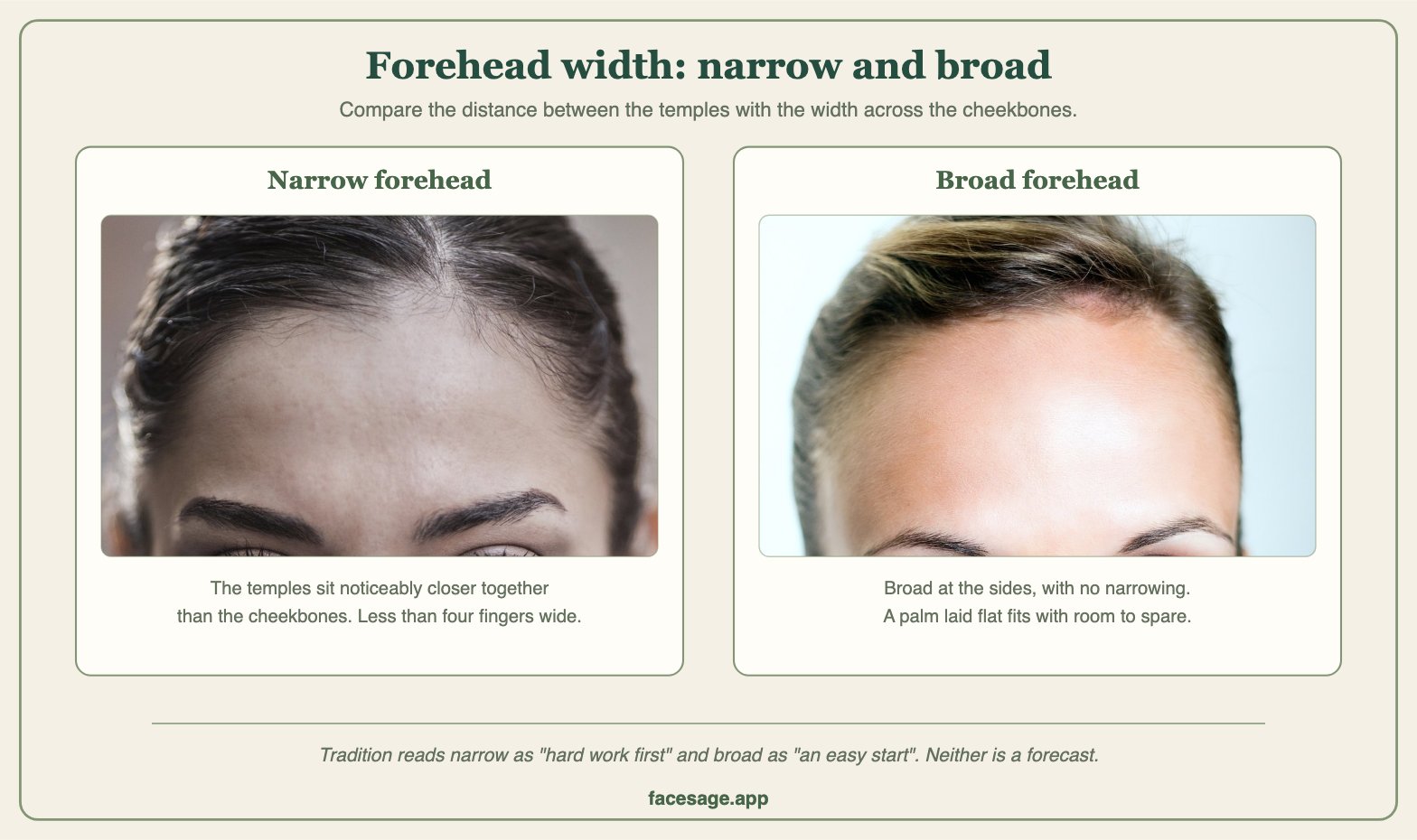
Why does a narrow forehead correspond to a poor early life? From the perspective of physiognomy, the forehead represents the initial resources given to you by “heaven”including family background, helpful people, and early opportunities. A broad forehead means that “heaven” provides a large stage, while a narrow forehead means that “heaven” provides limited starting space. That’s the logic. Think about the people around you with narrow foreheads; don’t they mostly share a common characteristic, they are exceptionally hardworking? It’s not that they are born with a love for hardship; it’s that they have no choice but to be forced into it. Lacking support in their early years, they had to earn everything themselves. Although this process was arduous, it laid an extremely solid foundation.
However, a narrow forehead doesn’t necessarily mean a narrow future. In physiognomy, there’s a saying: “bitter before sweet, narrow before broad”a narrow forehead combined with full cheekbones and a strong nose indicates a significant improvement in fortune after middle age. Those who have experienced hardship in their youth often have remarkable resilience in middle age. But this is merely a probabilistic tendency from a cultural perspective; in reality, each person’s character and destiny depend more on their upbringing and personal choices. People with narrow foreheads should be careful not to give up on themselves because of difficulties in their youth. Your best is yet to come, but only if you can endure the initial struggles.
A Broad Forehead: An Open Mind and Steady Middle Years
“A forehead as wide as a full moon signifies the presence of noble people.” What is the standard for a wide forehead? From the front, the hairline on both sides of the forehead should have a smooth, unrecessed curve, giving the entire forehead a “broad” feeling, like a flat field, without obvious depressions or a feeling of narrowness. If you can easily place your palm horizontally on your forehead with room to spare, then you have a wide forehead.
In physiognomy, a wide forehead corresponds to “abundant natural talent”not necessarily high intelligence (though it’s often not low), but rather that fate has provided them with favorable starting conditions. They may come from a good family, have encountered good teachers and friends from a young age, and always have someone to lend a helping hand at crucial junctures in their studies or career. People with wide foreheads tend to have a smooth youth, reaching a decent position without much hardship. This smoothness becomes even more pronounced in middle age, their career steadily advances, their network expands, and they achieve results with relatively little effort.

However, a wide forehead also presents some challenges. People with overly smooth sailing tend to have one flaw, they are easily broken. When faced with real setbacks, those with wide foreheads are more likely to crumble than those with narrow foreheads because they lack the experience of confronting difficulties from a young age. Another problem is “carelessness”thinking they can handle anything, only to stumble on details. The *Liu Zhuang Physiognomy* states, “Even a broad forehead without strong bones indicates superficiality.” This means that a broad forehead alone is insufficient; if the bones are weak and the skin is loose and flabby, such “smoothness” may only be superficial, lacking inner substance. Therefore, people with wide foreheads shouldn’t take smooth sailing for granted; they must learn to challenge themselves in favorable circumstances to go further. However, this is merely a probabilistic tendency from a cultural perspective. In reality, each person’s character and destiny depend more on their upbringing and personal choices.
A High Forehead: Natural Distinction That Stands Out
“A forehead three inches high exudes nobility; eyebrows reaching the heavens signify extraordinary talent.” What does a high forehead mean? It means the distance from the eyebrows to the hairline is exceptionally long, more than a third of the total face length. Some people, when their bangs are swept back, reveal a particularly prominent forehead, giving the impression of a “large forehead,” which is a typical sign of a high forehead.
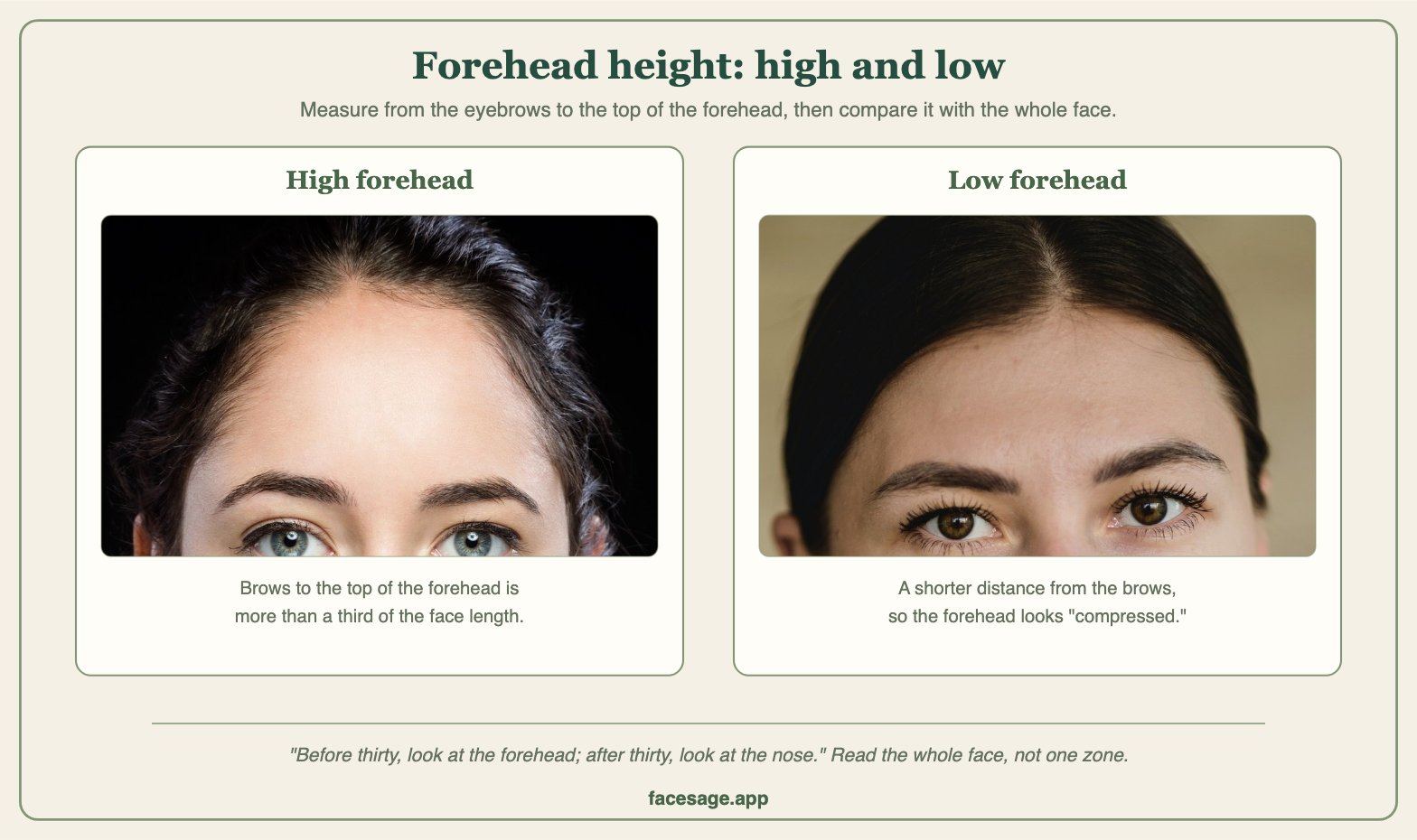
In traditional Chinese face reading, a high forehead signifies “nobility”note, nobility, not wealth. Nobility is a natural aura of advantage: people with high foreheads often have a broad perspective, lofty ideals, and ambitious goals; they disdain trivial matters and cannot stay in small circles. People with high foreheads are well-suited for leadership and decision-making roles; they naturally possess a perspective that allows them to “see far and wide.” In the workplace, people with high foreheads often advance faster than their peers because superiors can immediately recognize their “ambition.”
However, a high forehead isn’t all good. As the old saying goes, “a tall tree catches the wind,” meaning that people with very high and prominent foreheads are easy targets, people are already wary of you even before you’ve reached that position. Another common problem with people with high foreheads is being “ambitious but impractical”they can see the distant mountains, but are unwilling to diligently walk the path beneath their feet. Having lofty aspirations is good, but if they become detached from reality, it becomes unrealistic ambition. The ancient Chinese physiognomy text *Ma Yi Shen Xiang* says, “A high and round forehead undoubtedly indicates nobility; a high and pointed forehead indicates loneliness and punishment.” The same high forehead, round and full, signifies true nobility, while a sharp and protruding one carries a sense of “loneliness”capable but unsociable, talented but unpopular. Therefore, people with high foreheads shouldn’t just look to the sky; they also need to cultivate the ability to keep their heads down and work diligently. But this is merely a probabilistic tendency from a cultural perspective; in reality, each person’s character and destiny depend more on their upbringing and self-chosen choices.
A Low Forehead: Fewer Options, Not a Hopeless Future
“A low forehead means a winding road ahead, and it will take thirty years to get ahead.” A low forehead means that the distance from the eyebrows to the hairline is relatively short, the forehead area of the entire face appears “compressed.” Some people have particularly low hairlines, almost touching their eyebrows, which is the most typical example of a low forehead. Another situation is that the forehead is not low but it is obviously tilted backward, when viewed from the side, the forehead is not upright or slightly tilted forward, but rather “falls” backward. In face reading, this is also classified as “insufficient forehead strength.”
In face reading, a low forehead corresponds to a rather straightforward message: limited fortune in early life, and a tendency to hit a ceiling in one’s endeavors. Between the ages of fifteen and thirty, people with low foreheads often feel that “no matter how hard I try, I can’t get ahead”not because they lack ability, but because the timing isn’t right, the platform isn’t sufficient, and no benefactors appear. This feeling can lead many people with low foreheads into deep self-doubt in their twenties: Is this all I am? Am I destined to only reach this level in my life?
But don’t forget one thing, in face reading, it’s said, “Before thirty, look at the forehead; after thirty, look at the nose.” The forehead only governs the first half of one’s life; the nose governs middle age, and the chin governs old age. If someone with a low forehead has a straight, strong nose bridge and a full, rounded tip, they have a very high probability of turning their life around in middle age. To put it bluntly, a low forehead isn’t a death sentence; it just means your best role in this story will come later. Many people who achieve great things later in life have rather low and narrow foreheads, they were suppressed and confined in the past, but this actually accumulated enormous energy, and once they break through in middle age, their explosive power is even stronger than those who achieve success at a young age. However, this is just a probabilistic tendency from a cultural perspective. In reality, each person’s character and destiny depend more on their upbringing and self-choices. The biggest mistake people with low foreheads make is to accept their fate in their youth, the hardships you endure now will come back to reward you later.
A Prominent Forehead: Strong Will and a Stubborn Streak
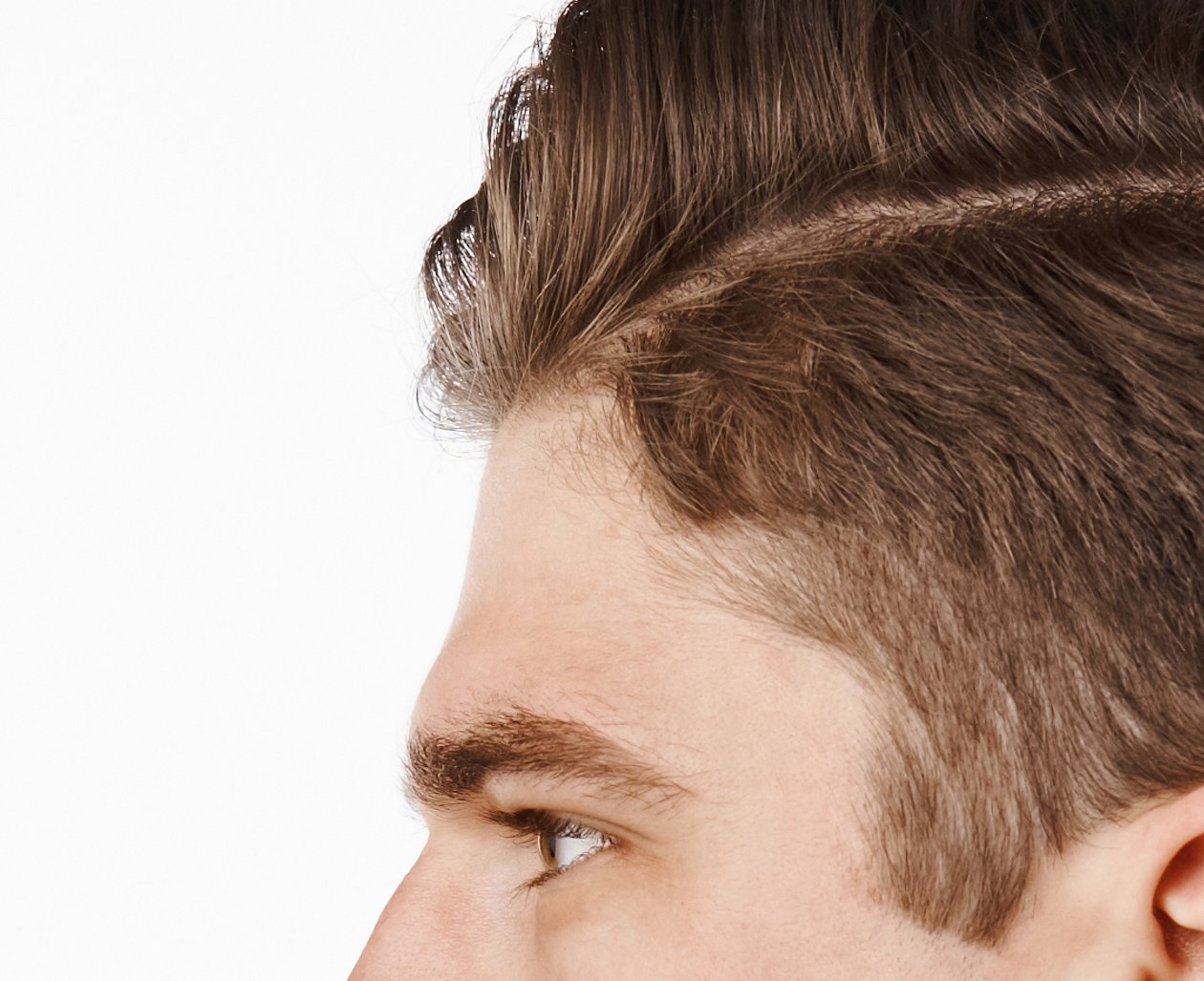
“A prominent forehead indicates strong opinions; once someone has made up their mind, nothing can sway them.” A prominent forehead doesn’t mean a high forehead, but rather that a bone in the middle of the forehead protrudes noticeably forward, especially noticeable from the side, like a bump on the forehead. In face reading, this type of forehead is called “prominent forehead bone,” and the corresponding personality traits are extremely opinionated and persistent.
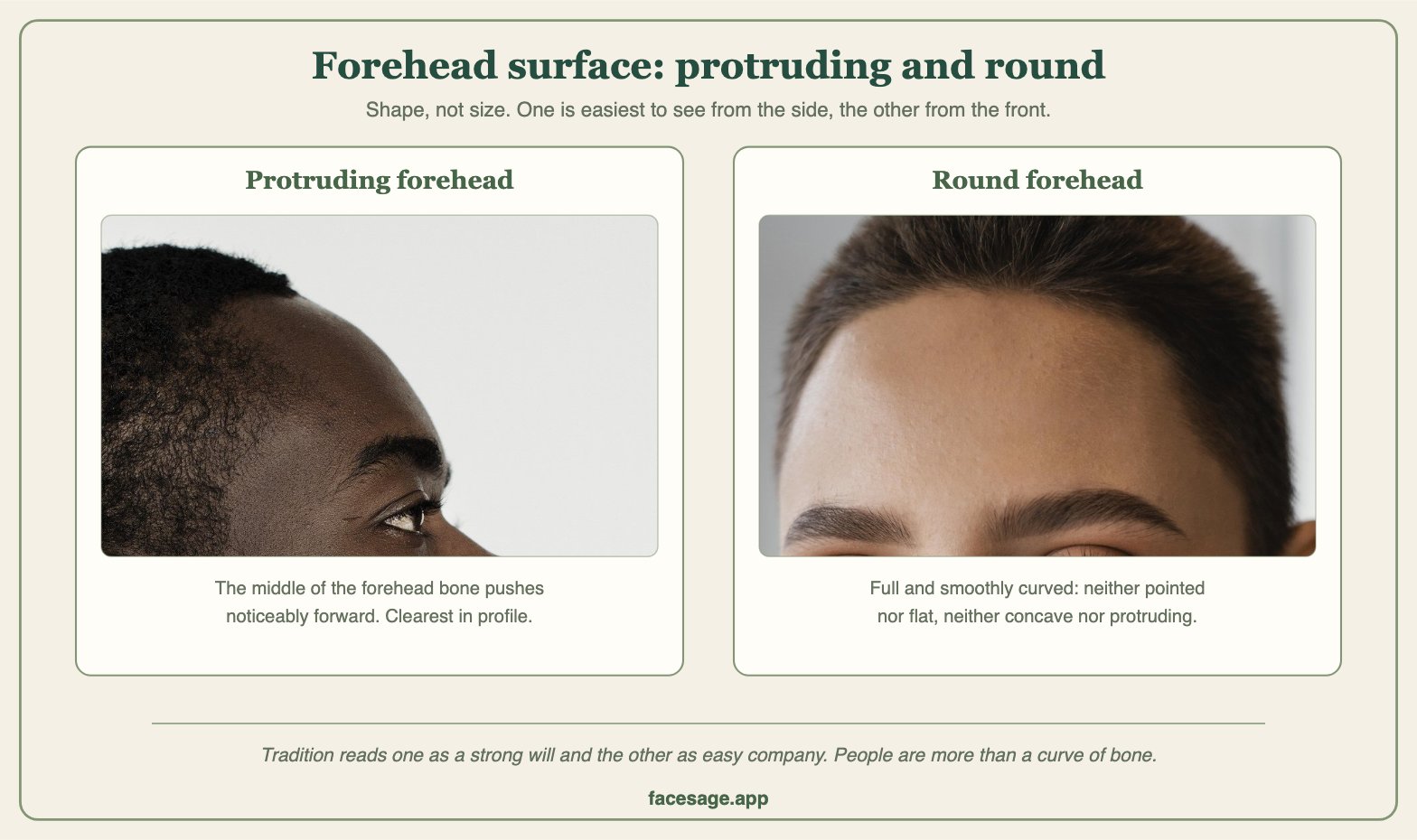
People with prominent foreheads are often the kind of “disobedient” children from a young age, not the kind who are mischievous and naughty, but the kind who say, “I have my own ideas, and I disagree with what you’re saying.” Once they’ve decided on a direction, no amount of persuasion will change their minds. This personality trait is a huge advantage when it’s right, they’ve already done it while others hesitate, and they persist while others give up. But it’s also a major pitfall when it’s wrong, they’ll stubbornly push forward even when it’s clearly a dead end, and they’ll refuse to turn when it’s clearly time to change course.
People with protruding foreheads tend to achieve success in their careers because they possess a relentless drive to succeed. However, they are prone to setbacks in interpersonal relationships, those who are too rigid cannot retain those who are more flexible. A person with a protruding forehead who can learn to soften their expression while adhering to principles is truly a “wise person.” But this is merely a probabilistic tendency from a cultural perspective; in reality, each person’s character and destiny depend more on their upbringing and personal choices.
A Concave Forehead: A Tendency to Overthink
“A pitted forehead indicates a heavy heart, with more thoughts than actions.” A pitted forehead refers to an uneven surface on the forehead with obvious depressions, it could be a depression in the temples or a horizontal indentation in the middle of the forehead; in short, it is not a full and smooth surface.
In physiognomy, a concave forehead corresponds to the characteristic of “overthinking.” Their minds are exceptionally active, but this activity is often directed not towards action, but towards internal contemplation. What is the result of overthinking? Indecisiveness. When it’s time to act, they think, “What if I fail?” When it’s time to express their opinion, they think, “Will what I say offend people?” People with concave foreheads often don’t lack ability or ideas; what they lack is the drive to “just do it!”
However, those with concave foreheads also have their advantages, their depth of thought often surpasses that of ordinary people. In fields requiring in-depth analysis and strategic planning, those with concave foreheads actually have an advantage over those who “act without thinking.” They are well-suited for research, planning, writing, and serving as behind-the-scenes strategists. The only concern is in situations requiring quick decision-making, their hesitation can cause opportunities to slip through their fingers. But this is merely a probabilistic tendency from a cultural perspective; in reality, each person’s character and destiny depend more on their upbringing and self-choices.

A Round Forehead: Warm, Kind and Approachable
“A round forehead like jade signifies good interpersonal relationships; wherever you go, you’ll find companionship.” A round forehead, viewed from the front and side, presents a full, rounded, and edgeless appearance, neither pointed nor flat, neither concave nor protruding, like a smoothly polished piece of jade. In traditional face reading, this forehead shape is considered a “lucky face”not the kind of aura of great wealth and nobility, but rather an aura that makes people feel close, comfortable, and willing to associate with them.
People with round foreheads have a great advantage in that they are well-liked. They speak kindly, act without being extreme, and always leave room for others in their interactions. When is this personality trait most useful? When cooperation is needed. When you reach a certain level in your career, it’s not about individual ability, but about whether you can unite enough people to work with you. People with round foreheads naturally have this ability, others are willing to cooperate with them, help them, and stand by their side in crucial moments.

It’s important to note that people with round foreheads tend to be “too smooth”they try not to offend anyone and lack a clear stance, which may ultimately make them seem unprincipled. Physiognomy says, “A true character is one that is round yet square”a gentle, rounded appearance is the foundation, but the ability to stand out in crucial moments is what truly signifies greatness. However, this is merely a probabilistic tendency from a cultural perspective; in reality, each person’s character and destiny depend more on their upbringing and personal choices.
What Makes a Forehead Stand Out in Face Reading?
So far, we’ve covered the width, height, protrusion, and shape of the forehead. Now, look in the mirror and see which category you fall into. Perhaps you find your forehead narrow and low, and you’re a little worried, don’t panic. As I mentioned before, physiognomy is never about judging success or failure based on a single feature. And don’t forget the title’s line, “Truly wealthy and noble people invariably have this one thing on their foreheads.” This thing has no direct relation to whether your forehead is wide or narrow, high or low, round or square. It’s an independent, unique feature. Some people have narrow foreheads but possess this feature and still achieve great wealth and status; others have broad, round foreheads but lack this feature, leading to a smooth life but never reaching the level of “great wealth and status.”
At this point, you might be wondering: What exactly is it?
The thing that transforms a forehead from “ordinary” to “noble” is called the “Crouching Rhinoceros Bone”.
“A prominent ‘crouching rhinoceros bone’ on the forehead signifies the rise of high-ranking officials and generals.” This saying carries immense weight in physiognomy, in traditional physiognomy books, the phrase “crouching rhinoceros bone” is almost always mentioned when discussing “signs of great nobility.” What is a crouching rhinoceros bone? Let me explain.
How to Recognize the Crouching Rhinoceros Bone
The fuxi bone is not a “bone protruding from the forehead” in the general sense. Many people have protrusions on their foreheads, but that may just be normal frontal bone development, an irregular, one-sided, localized small bump. The fuxi bone is different from these; it has a very clear morphological standard.
The book *Ma Yi Shen Xiang* describes it as follows: The *fuxi* bone originates above the glabella (the area directly above the midpoint between the eyebrows), extending upwards along the midline of the forehead, all the way to the Baihui acupoint on the top of the head. Its shape is not sharp or abrupt, but rather rounded and raised, like a reclining rhinoceros horn, flat against the center of the forehead, stretching upwards. It doesn’t look jarring, but feels very substantial to the touch. It’s especially noticeable from the side, from the brow ridge to the hairline, there’s a clearly visible ridge in the middle, neither high nor protruding, but powerfully continuous.
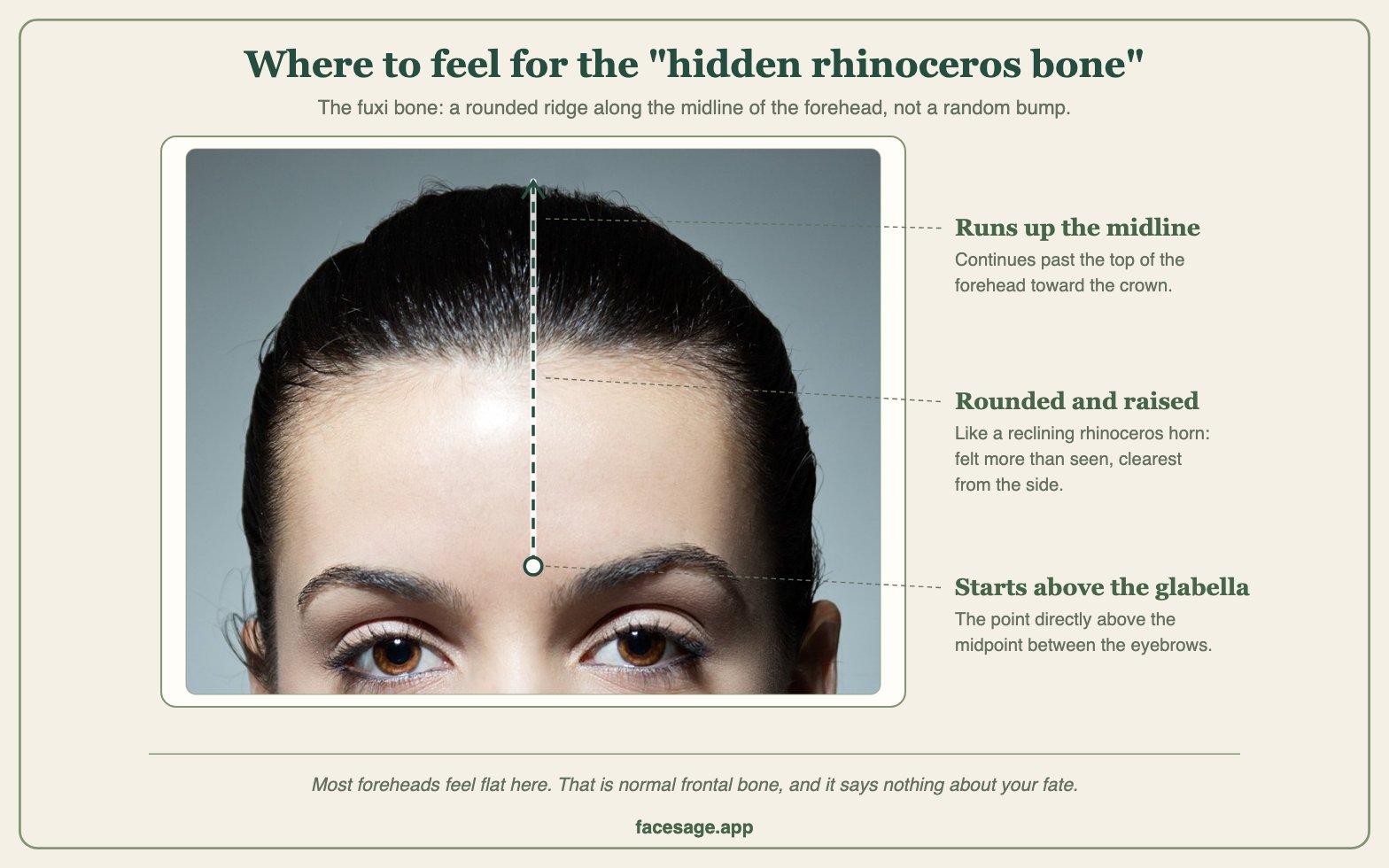
Why is this bone so special? From the perspective of physiognomy, the Fuxi bone corresponds to the “main axis of essence, energy, and spirit.” In traditional Chinese medicine and physiognomy, a person’s essence and energy rise from the dantian (lower abdomen), travel up the spine, and finally converge at the top of the head, this path is projected onto the face as the midline from the glabella (between the eyebrows) to the forehead and then to the top of the head. A person with a well-developed Fuxi bone signifies abundant innate essence and energy, extremely vigorous energy, and exceptionally strong willpower. Such people have a very prominent characteristic, they can endure. Not the kind of stubborn endurance, but a kind of inexhaustible, continuous, and inexhaustible stamina from within. Observe those who truly achieve great things; they are not necessarily the smartest, nor are they necessarily the most well-connected, but they have one thing in common: they are still doing what others have long given up on, and they are doing it with increasing vigor. The external sign of this “infinite endurance” in physiognomy is the Fuxi bone.
The Three Grades of the Crouching Rhinoceros Bone
The *Liu Zhuang Physiognomy* further divides the “Crouching Rhinoceros Bone” into three levels. The first level is called “Crouching Rhinoceros Bone Extending to the Top of the Head”the bone extends continuously from the glabella to the top of the head, without weakening or breaking in the middle. This is the highest level of nobility; traditional physiognomy books say such people “will be granted titles and honors,” which translates to reaching the top position in an industry or field. The second level is called “Crouching Rhinoceros Bone Entering the Forehead”the bone only extends to the middle of the forehead and doesn’t reach the top. Such people also possess nobility, but their potential is smaller than the first level. They are likely to become mid-to-high-level managers or influential figures in their industry, but not necessarily at the very top. The third level is called “Crouching Rhinoceros Bone Slightly Appearing”the bone only slightly protrudes near the glabella, not very noticeable but definitely present. Such people have good fortune in terms of connections and career, better than ordinary people, but not reaching the level of “great nobility.”
How to Check Your Own Forehead
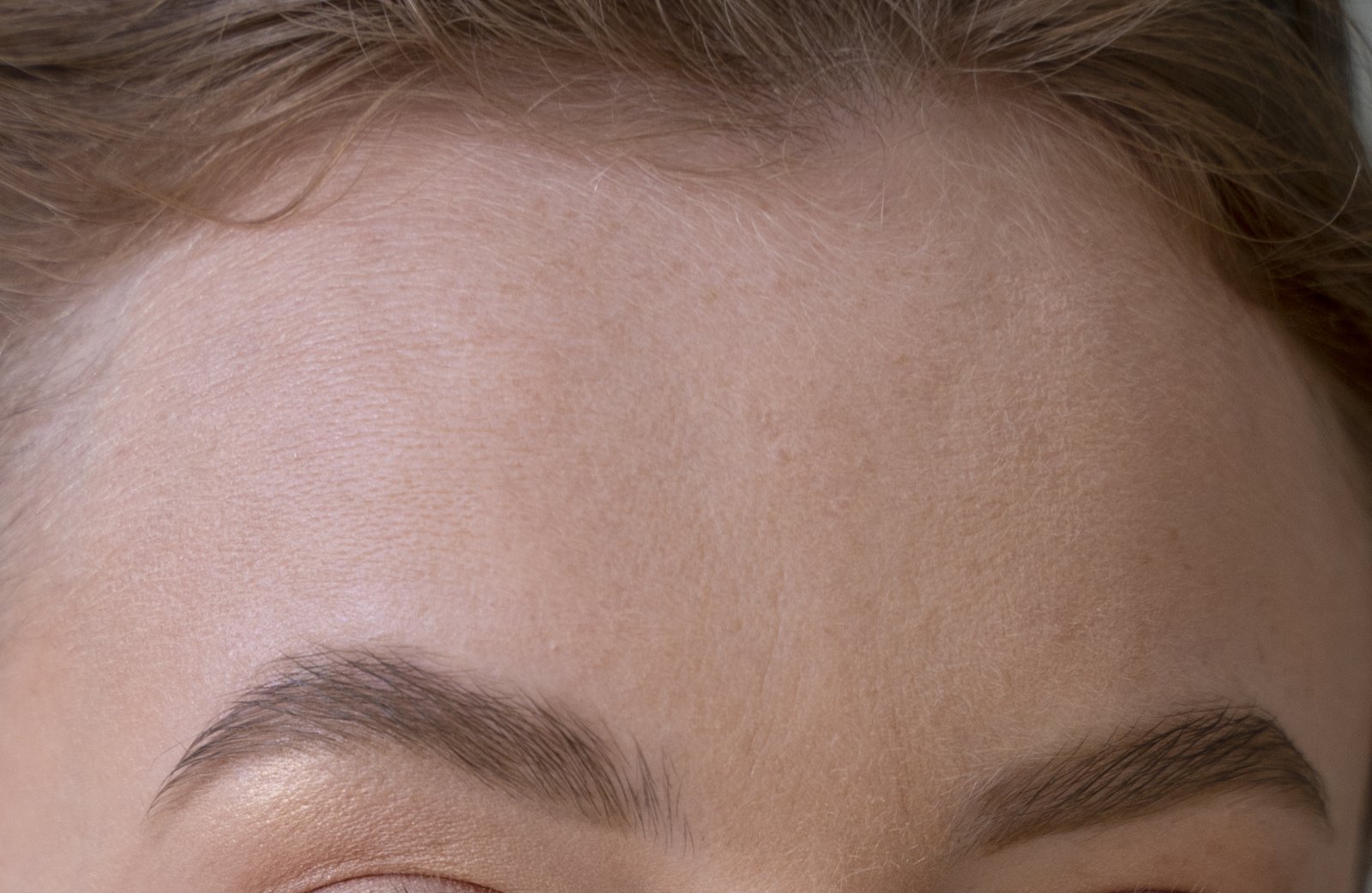
Now, look in the mirror and touch the center of your forehead, starting from between your eyebrows and moving upwards, to see if there’s a raised line. Note that a bulging forehead doesn’t necessarily mean it has a prominent bone, it must be a clear, bony raised line along the midline. Many people touch their foreheads and find they’re flat, with nothing there, this doesn’t mean you have a bad fate; it just means you might be on a different path at the “greatly noble” level. Facial features are only one aspect of life, not the whole picture.
The Price of a Prominent Forehead Bone
However, having prominent “Fu Xi Bone” (a type of bone structure) doesn’t come without a price. The old saying goes, “Nobility comes from hardship”people with prominent “Fu Xi Bone” often don’t have an easy youth. They may have experienced great pressure, heavy responsibilities, and deep setbacks in their early years. These experiences, which others may see as suffering, are precisely what “tempering” those with well-developed “Fu Xi Bone”just as good steel needs to be forged through countless hammer blows to become a useful tool. Look at those who ultimately achieve great wealth and status; almost none of them had a smooth journey, although they possess noble bone structure on their foreheads, the first half of their lives is often filled with thorns. “Fu Xi Bone” doesn’t give them a smooth road, but rather the ability to reach the summit after traversing that difficult path. This is merely a probabilistic tendency from a cultural perspective; in reality, each person’s character and destiny depend more on their upbringing and self-choices.
Another detail worth mentioning is the “texture” of the rhinoceros bone. If the bone is prominent but the skin and flesh are loose and the color is dull, it indicates that although one possesses innate vital energy, it has been severely depleted through acquired means, perhaps due to chronic sleep deprivation, excessive indulgence, or carrying heavy burdens in one’s mind for a long time, which has drained the person. Conversely, if the skin around the prominent rhinoceros bone is firm and has a bright, lustrous color, it indicates that the person’s vital energy is not only abundant from birth but also well-maintained through proper care, this is the true “sign of great nobility.” The *Shenfeng Tongkao* aptly states, “The bones should be prominent and elegant, not coarse and turbid.” This applies equally to the rhinoceros bone, having bone is fundamental, but a refined and elegant bone structure is the true mark of superiority.

Can Your Forehead and Your Fortune Change?
On the other hand, what if you look in the mirror for a long time and confirm that you don’t actually have a prominent forehead bone? Does that mean you’re destined to be unlucky and poor?
Here’s a crucial point in physiognomy: “Your appearance reflects your heart, and your bones change with your life.” What does this mean? Your facial features aren’t static; they change with your life experiences, mindset, and habits. The most typical example is the “glabella” (the area between the eyebrows): if you maintain a cheerful and positive outlook, this area will become increasingly bright and open; if you’re chronically gloomy, anxious, and resentful, it will become increasingly dark and narrow. While bones don’t change as easily as flesh, the “aura” of the facial bones is still influenced by one’s overall spirit and energy after middle age. A person with a flat forehead in their youth, if successful, stable, and energetic in middle age, will have a different “aura” in their forehead, although the bones didn’t grow out of thin air, the overall aura, luster, and fullness of the forehead area will significantly improve. Forehead lines are read in a similar spirit, and our guide to lucky face lines and wrinkles explains why clear, orderly lines such as the three horizontal forehead lines are treated differently from tangled ones.
So don’t view facial features as a verdict; they’re more like a map, telling you where you are and what the road ahead might be like. But where you go and how you get there is entirely up to you. People with narrow foreheads can broaden their horizons through hard work, those with low foreheads can accumulate experience and wait for their moment to turn things around, and even those without prominent facial features can forge their own path through ability and character. The greatest value of physiognomy isn’t about labeling yourself or defining your destiny, but about understanding your innate tendencies and then strategically playing to your strengths and minimizing your weaknesses.

Final Thoughts on Forehead Face Reading
Finally, I must emphasize again, facial features require a holistic view. You can’t draw conclusions just by looking at the forehead. The forehead is like the opening move in a game of chess. A strong opening is good, but if the middle game (nose, cheekbones) is played poorly, the whole game can be lost. Conversely, a bad opening isn’t a problem; if the middle and endgame (chin, nasolabial folds) are played strategically, you can still win. The last chapter of *Ma Yi Shen Xiang* specifically discusses this principle: “The five peaks must be balanced; any one that is unbalanced is a deficiency.” The five “mountains” must coordinate and cooperate; even the tallest single peak cannot support a good face. If you want to truly understand your facial features, the best way is not to focus on one particular area, but to step back and look at the whole, is the first impression of your face “refined and spirited” or “dull and weak”? Is it “balanced and harmonious” or “something particularly striking”? The amount of information hidden in the first impression is far greater than what you would find in measuring the width of your forehead. However, this is only a probabilistic tendency from a cultural perspective. In reality, each person’s character and destiny depend more on their upbringing and personal choices.
So you see, the question at the beginning has an answer. The width, height, roundness, squareness, protrusion, and depression of the forehead govern the smoothness or roughness of a person’s early life, and the abundance or scarcity of their natural talents. But the key factor that truly propels a person from “ordinary” to “great nobility” is the “crouching rhinoceros bone”it represents not luck, but the foundation of one’s spirit and the depth of one’s willpower. People with this bone don’t become rich overnight; they also have to experience hardships and put in the same effort. It’s just that their “ceiling” is higher and their “endurance” is longer than others. In short: appearance is a trump card, not the answer. How you play the game of life is something you have to walk step by step yourself.
Keep reading
What Is Face Reading and What Can It Tell You?
What Is Face Reading (Physiognomy)? Physiognomy is a folk art of fortune-telling that involves observing a person’s facial features, and strictly speaking,…
The Face Reading Chart Guide to the Twelve Palaces
“If you have a heart but no appearance, your appearance will follow your heart; if you have an appearance but no heart,…