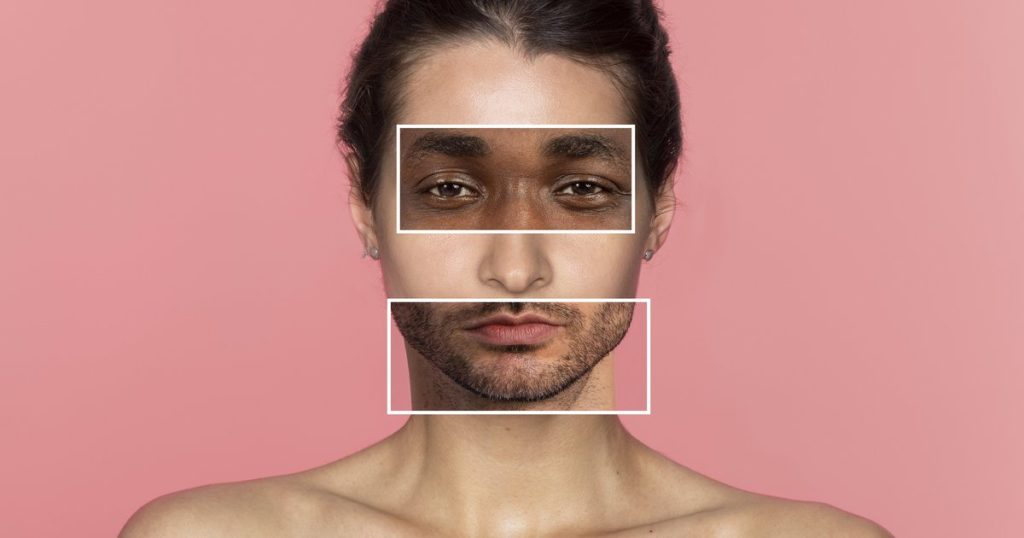
Is Face Reading Accurate? What Your Intuition Picks Up
You must have had this intuition:
When you first meet a stranger, you automatically form a judgment in your mind without even having to talk to them.
Some people have ordinary features, yet they inspire trust and closeness at first glance; others are exquisite and eye-catching, yet they exude an aloofness and hostility, making people instinctively wary and hesitant to get to know them closely. Reading character from faces like this is an old practice, and why physiognomy is called a pseudoscience explains both the criticism and what the tradition still records.
There’s an old saying: “Look at the eyelids to see if someone is good or evil, and look at the lips to see if someone is true or false.” Many people consider physiognomy to be feudal superstition.
However, numerous psychological experiments, gene sequencing, and AI personality assessment studies have long confirmed that the saying “your appearance reflects your inner self” is not a metaphysical notion, but rather a real mark left on your face by long-term emotions and life experiences.
Appearance is 30% genetic and 70% cultivated. Your face is the most direct external reflection of your personality, mentality, and character.
Is Your First Impression of a Face Accurate?
Many people think that judging a person by their appearance is too superficial, but science has proven that human intuition for judging people is far more accurate than imagined.
Face perception research shows that the brain only needs 0.1 seconds (100ms) to quickly determine the credibility, aggression, and friendliness of a stranger.

This instantaneous intuition often aligns closely with the understanding gained through long-term interaction.
An experiment conducted by Carré’s team at Brock University in Canada has confirmed that people’s judgments of a stranger’s aggressiveness are significantly positively correlated with the individual’s actual behavior and personality.
Why Are First Impressions So Accurate?
The 43 facial muscles are directly connected to the central nervous system and are not constrained by the skeleton. Paul Ekman, the father of microexpressions, discovered that while people can deliberately lie, subconscious emotions can affect muscles within 0.2 seconds, leaving traces that cannot be faked.
Temporary emotions can be faked, but long-term mindset and habits will be like water polishing a stone, fixing them into fixed facial lines and expressions, becoming facial features that are difficult to change.
The Two Scientific Ideas Behind Face Reading
The core of judging a person by their face lies in two fundamental principles: genes and hormones shape one’s innate character, while emotions and habits sculpt one’s acquired appearance.
Hormones and Genes Shape Innate Personality
The human face is a direct display of hormones and genes; appearance is never randomly generated.
Studies have confirmed that the larger the face width-to-height ratio in men, the higher their testosterone levels, the more assertive and competitive their personality, and the higher the probability of impulsiveness and aggression. The old saying “square-faced men are not to be trifled with” is precisely an ancient summary of hormonal patterns.
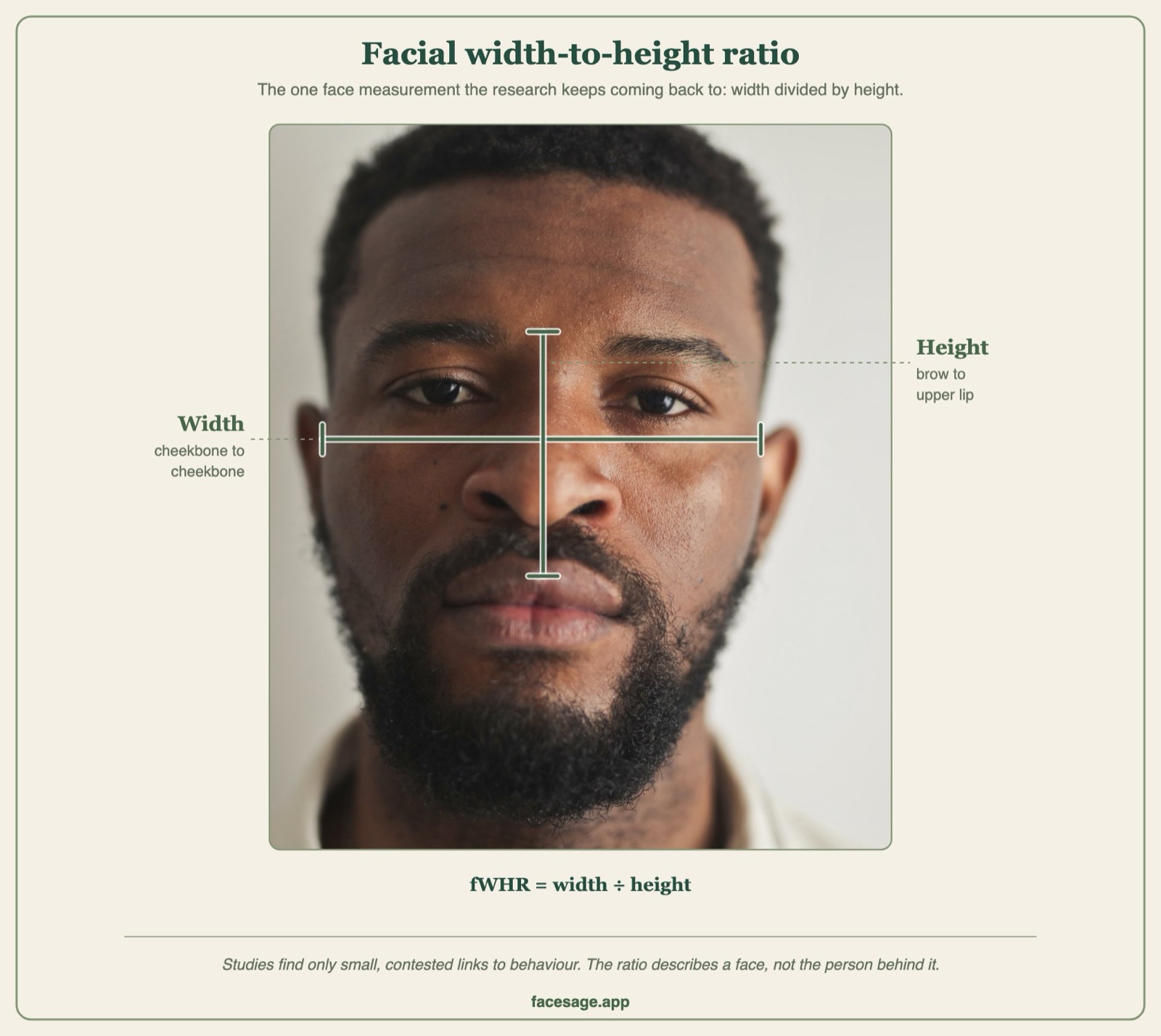
Facial features also reveal personality traits:
Prominent brow bones: Higher testosterone levels, stronger leadership and control.
Thicker lips: Higher estrogen levels, more emotional personality, and stronger empathy.
Wide-set eyes: Lower cortisol levels, more stable emotions, and a more relaxed mindset.
Even more revolutionary is that core genes such as PAX3 and TBX15 simultaneously control the development of facial features and the brain’s emotional center.
In short: appearance and personality share the same genetic code, which is the root cause of the great differences in people’s personalities.
Facial Feedback: How Emotions and Features Shape Each Other
The facial feedback hypothesis in psychology challenges conventional wisdom: appearance is not predetermined, and emotions and facial features have a two-way relationship of shaping each other.
The classic experiment in 1988 and the big data study of 10,000 people in 2019 have both confirmed that facial expressions are not only the result of emotions, but can also reverse and dominate emotions.
A deliberate smile can generate feelings of pleasure, while a constant frown and tension can exacerbate anxiety and depression.

Repeated micro-expressions over a long period of time can solidify into permanent facial muscle memory.
Constantly irritable and tense, with lines etched between the brows; perpetually complaining and pessimistic, with the corners of the mouth permanently drooping; habitually calculating and deceitful, with eyes that naturally carry a detached scrutinizing air.
Before 30, looks are largely determined by genetics; after 30, looks are largely determined by self-cultivation.
Four Facial Features Said to Reveal True Character
Combining psychology and traditional wisdom in judging character, these four facial details can quickly reveal a person’s true nature. They are simple, practical, and highly accurate.
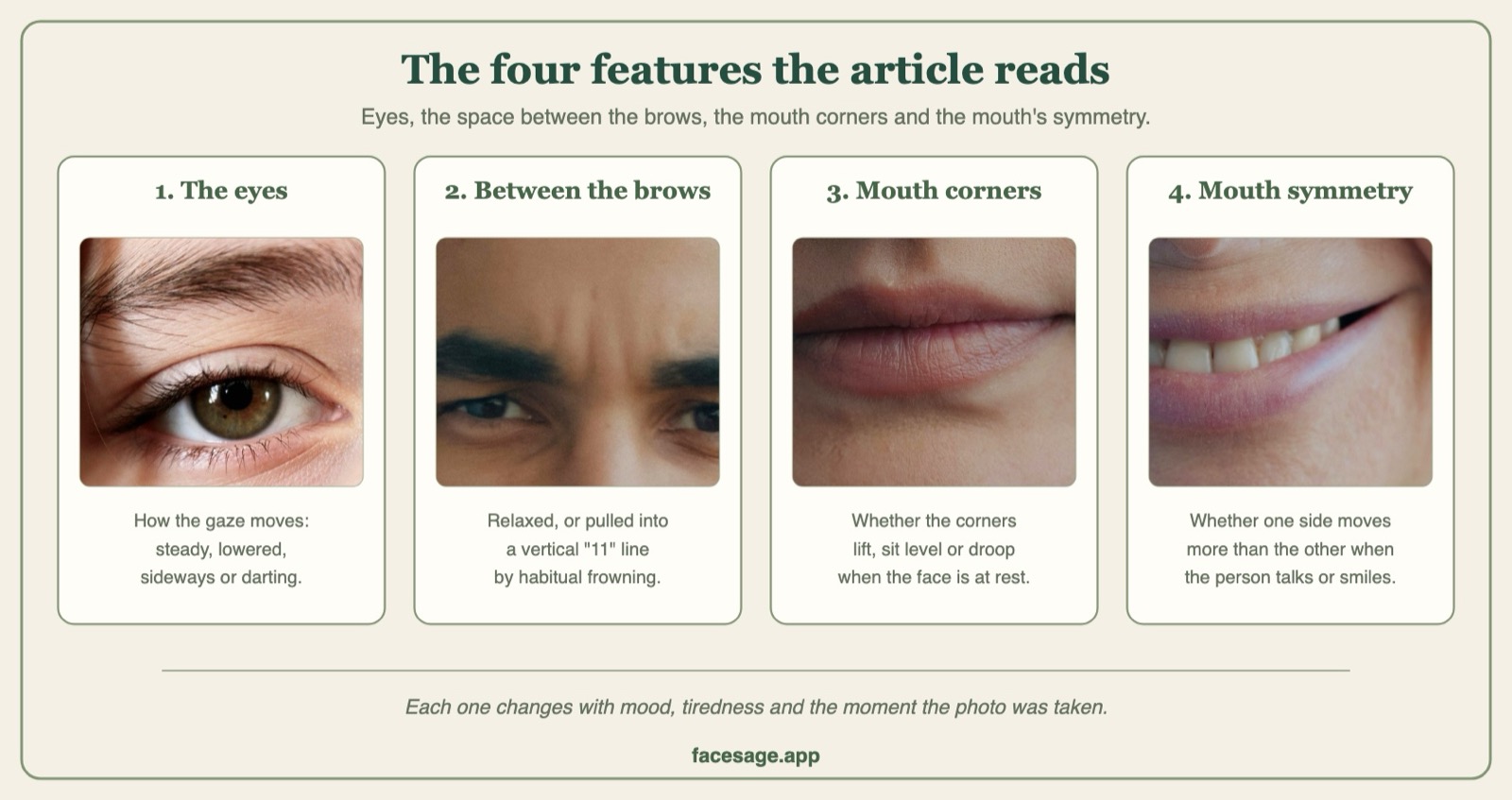
Look at the Eyes
The eyes reveal a person’s true character and shrewdness.
The muscles around the eyes are the hardest to fake; your eyes reveal your true personality.
A downward-looking, inquisitive gaze = a deep-seated, calculating nature.
An old saying goes, “Those who look down are sullen, and those who peer sideways are cunning.” People who habitually look down or peer sideways are deep-seated and calculating. A long-term habit of scrutinizing and calculating will cause tight, downward-sloping lines to form at the corners of their eyes, devoid of warmth, making others feel as if they are being weighed against.
A gloomy, half-open gaze = cunning and controlling.
These people are reserved and composed. They often observe others’ discussions with a detached eye, secretly weighing the pros and cons and calculating gains and losses. They have a strong desire for control, exude an aura of intimidation, and are difficult to approach.
Shifty eyes and a evasive demeanor indicate a lack of security and hidden motives.
Zeng Guofan, in his book “Bingjian,” described this type of gaze as “floating eyes.” People who avoid eye contact and whose eyes dart away when speaking are insecure, lack confidence, and are constantly on edge. They may appear gentle, but in reality, they are selfish and harbor hidden aggression.
Three-white eyes and four-white eyes = strong personality and weak empathy
People with “three-white eyes” or “four-white eyes” (where the whites of the eyes are mostly visible and the pupils are relatively small) are often in a state of dominance and rage, with overactive sympathetic nervous systems. These individuals tend to be strong-willed, lack empathy, act impulsively and stubbornly, and are prone to arguments.
Look at the Area Between the Eyebrows
The lines reveal your emotional turmoil.
The space between the eyebrows is a barometer of one’s temperament: those with relaxed eyebrows and eyes are stable, open-minded, and insightful at heart; those with furrowed brows are mostly overthinking and constantly expending internal energy.
Many young people have a clear vertical line between their eyebrows, a vertical line resembling a hanging needle.
People who are chronically anxious, perfectionistic, and have a strong desire for control will have their brow muscles constantly contracted, which over time will lead to the formation of stubborn vertical lines.
People with a vertical line between their eyebrows are persistent and responsible, but they are prone to getting stuck on trivial matters, excessive internal conflict, and are very harsh on themselves and others, giving off a repressive aura.

Look at the Corners of the Mouth
The curve reveals your underlying mindset.
The muscles around the mouth are connected to the brain’s emotional mechanisms, and a person’s long-term state of mind will ultimately be reflected in the curve of the corners of their mouth.
An ancient physiognomy book says, “A mouth like an overturned boat, with drooping corners, indicates a lot of resentment.” This refers to an overturned boat mouth: in its natural state, the corners of the mouth droop, the nasolabial folds are deep, and the face looks tired and bitter.
These people have a pessimistic and negative mindset, are used to complaining and criticizing, and are prone to self-destruction. Even if life is going well, they often harbor resentment and bring their own negative energy field, which can easily drain those around them.
Traditional Chinese medicine believes that “excessive thinking leads to qi stagnation.” Long-term depression and anxiety can cause poor blood circulation in the spleen and stomach, resulting in facial muscles losing support, which in turn leads to sagging and a resentful appearance.
Observe the Shape of the Mouth
Asymmetry indicates inconsistency between words and actions.
People whose faces appear normal in daily life, but whose mouths become noticeably crooked when speaking or when emotionally agitated, should be viewed with caution.
This is a typical example of cognitive dissonance: long-term inconsistency between words and actions, deliberate pretense, and continuous conflict in the brain nerves eventually lead to uneven facial muscle exertion and asymmetrical appearance. Face reading also gives each side of the face its own meaning, and the left and right sides in face reading explains the left for men, right for women rule and why both sides are read together.
These types of people are skilled at creating a persona, saying one thing to your face and another behind your back. They are extremely defensive and it is difficult for them to trust you sincerely.
Why Do Some Faces Feel Out of Harmony?
Some people in life have exquisite features, yet they give off an awkward feeling and make people feel wary, with a strong sense of facial disharmony.
This has nothing to do with appearance; it is essentially an outward manifestation of inner conflict and inconsistency between one’s inner and outer self.
Everyone has an innate personality and temperament, but many people forcibly pretend to be different in order to conform to worldly norms and please others.
Disliking social interaction but forcing a smile, feeling exhausted inside but pretending to be cheerful.
The subconscious desire for relaxation clashes with the deliberate rational attempt to accommodate others, leading to long-term emotional drain and ultimately creating a sense of estrangement, a forced smile that is both friendly and distant.

In short: Your face holds all your insincerity and inner turmoil.
Changing Your Face by Cultivating Your Mind
Many people worry: If my face looks bad, does that mean my life is already set?
Please remember: facial features are a probability, not a destiny; they are trends, not conclusions.
AI-powered facial analysis has an accuracy rate of only 90%. Genetic appearance only determines innate tendencies and cannot compete with self-cultivation. Identical twins may share the same genes and appearance, but their different experiences and mindsets can lead to drastically different life qualities.
True appearance reflects the heart; when the heart changes, the appearance changes accordingly.
Here are 3 scientific methods for cultivating a pleasing and elegant facial appearance, easily developing a graceful and sophisticated aura:
Quit Negative Language and Cultivate a Peaceful Aura
Language carries its own psychological suggestion. Constant complaining and negative venting will keep your facial muscles tense, making your face look increasingly sorrowful.
Replace complaining with problem-solving, internal conflict with acceptance, and reduce entanglement and resentment; your eyes and brows will gradually become more relaxed and gentle.
Build Inner Strength and Reduce Emotional Outbursts
A tense facial expression indicates inner instability. Practice meditation for 5-10 minutes daily, focusing on regulating your breath, and remain calm and composed in the face of adversity, without agitation or resentment.

Once you have a stable mindset, your stress hormones tend to stabilize, the lines between your eyebrows gradually fade, your eyes become clear and determined, and your aura becomes more calm and composed.
Gain Knowledge and Experience for a Clearer Temperament
Physical beauty will eventually fade with age, but the charm cultivated through knowledge and experience becomes more captivating with time.
Read more books, reduce internal conflict, broaden your mind, and let go of obsessions; the anger and bitterness on your face will gradually dissipate, replaced by openness, relaxation, and gentleness.
Is Face Reading Real? Final Thoughts
Traditional physiognomy is not feudal superstition, but rather a psychological and behavioral statistical approach to emotions that has been passed down for thousands of years.
It teaches us to recognize and distinguish people, but it never advocates stereotypes, prejudices, or judging people by their appearance.
Our physical appearance is a gift, but a relaxed and graceful demeanor is a form of self-cultivation.
Every act of forgiveness and letting go, every instance of emotional stability, is a step towards becoming a better version of yourself.
Cultivating the mind leads to cultivating the face; a calm and composed face, reflecting emotional stability and inner clarity, is the best feng shui for a person’s life.
Keep reading

Is Physiognomy Pseudoscience or a Record of How We Live?
“Your appearance is clearly extraordinary; you’re destined for great wealth and high status.” Many people heard similar things when they were young,…
Why Psychology Says Face Reading Hints at Personality
In life, we often have this experience: a casual glance in a crowd, and we have a strange feeling about someone. This…