
Physiognomy AI · The scan is free
Physiognomy,
read by AI.
FaceSage is physiognomy AI you can try right now. Upload a photo and the AI reads your features against face-reading traditions in about a minute.
Try physiognomy AI on your photo
Upload one clear photo. The AI scan is free.
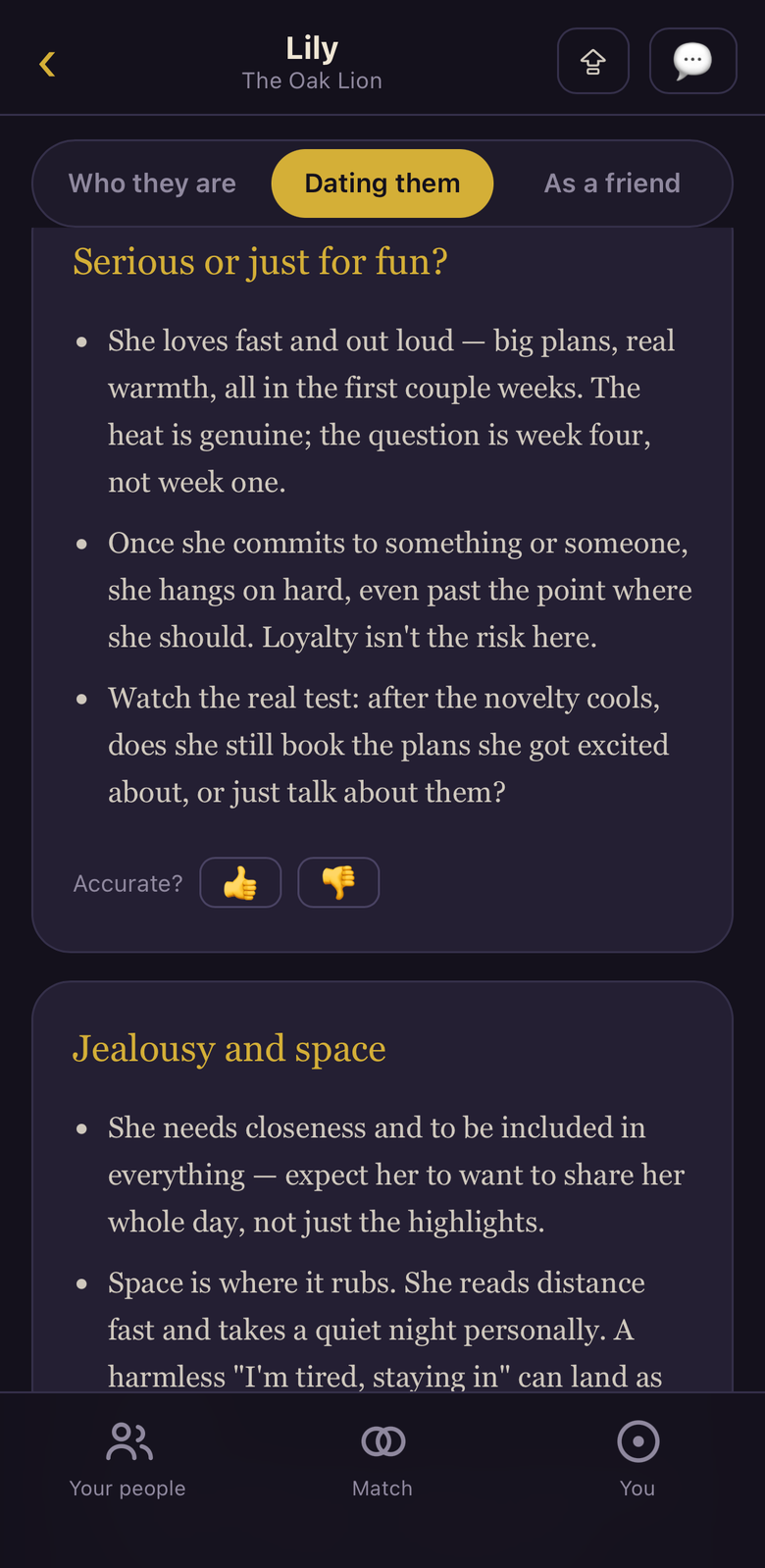
Your results from one photo.
Upload a photo and your free results show up right away. No email, no card.
Free with every scan
Your archetype
A name for how your face reads, like the Oak Lion or the River Swan, with a short description of the personality behind it.
Six first-impression scores
How your face comes across to people meeting you for the first time:
- Warmth
- Trust
- Competence
- Takes charge
- Social energy
- Presence
With a full reading
Your written personality reading
The traits and habits face-reading traditions link to your features, written for you.
Dating and friendship readings
How you are as a partner and as a friend, with scores like:
- Affection
- Long haul
- Space needs
- Loyalty
- Give and take
- Even temper
Five follow-up questions
Ask anything about your reading and get an answer based on it.
Three steps. No download.
FaceSage works in your browser, on your phone or your computer.
Choose a face
Upload a clear, front-facing photo. Start with yourself or someone you’re curious about.
See your first results
The app measures the face and shows the archetype name and first-impression scores.
Open the full reading
If you want the written reading, buy one read. It opens the character, dating, and friendship readings and five follow-up questions.
How physiognomy AI reads your face
The app measures your face on your device, including the shape and spacing of your eyes, brows, nose, lips and jaw.
The AI then matches those measurements to descriptions from Chinese mian xiang, Indian samudrika shastra and Western face reading, and writes your reading.
Physiognomy AI uses artificial intelligence to turn facial appearance into interpretations of character or personality. For someone curious about face reading, the appeal is an accessible starting point: a photograph becomes something to explore, with attention drawn to features you might usually overlook. Understanding how the software moves from a visible feature to a personality description helps you get more from the experience.
An old curiosity meets a new tool
Physiognomy connects outward appearance with ideas about inner character. In European history, Johann Caspar Lavater helped popularize the practice through illustrated writing and public discussion. Its influence extended into portraiture and, more troublingly, racial classification and policing, as the National Library of Medicine’s exhibition documents. The debate over physiognomy as pseudoscience weighs that verdict against what the practice records about how people live.
Here, “physiognomy AI” means the general category of AI face reading. A particular tool might draw on a named tradition, a developer’s interpretation system, or statistical research. Those origins matter: they tell you what kind of reading you are exploring.
Facial recognition asks who appears in an image. Physiognomy asks what appearance might mean. Software can perform the first task without establishing the second.
How a photograph becomes a reading
A useful way to understand a report is to separate three steps:
- Observing the image. Software may locate points around the eyes, nose, and mouth, then describe their positions or proportions. Google’s MediaPipe Face Landmarker, for example, produces facial coordinates and expression-related outputs.
- Assigning meaning. A developer could connect observations to traditional interpretations. Alternatively, a model can learn patterns from photographs paired with labels, such as personality questionnaire scores.
- Writing the report. The results can be presented through prepared descriptions or generated prose. The wording makes the interpretation readable; its basis comes from the preceding steps.
This is a conceptual guide, not a verified recipe for every app. Imagine a report describing eyebrow shape, then discussing independence. The shape is an observation; independence is an interpretation whose source you can explore. A helpful explanation makes that connection visible rather than leaving you with an unexplained adjective.
What does “accurate” mean here?
Accuracy depends on the task. Following a traditional source faithfully, matching people’s first impressions, and predicting independently measured personality are different achievements. Agreement with a face reader can demonstrate consistency with that reader’s approach; it cannot alone establish a person’s actual traits.
There is research worth understanding. A 2020 study by Kachur and colleagues used photographs and Big Five personality questionnaires from 12,447 volunteers. For 1,245 participants held out of training, predicted and self-reported scores had correlations of 0.14–0.36. These were modest associations, not percentages of people correctly described.
The sample consisted mostly of white, Russian-speaking adults. The researchers also could not fully separate facial structure from photographic choices, including expression, makeup, and camera angle. The findings therefore do not validate traditional feature meanings or establish reliable personality readings for any consumer app.
A stronger predictive claim would need independent testing on new populations, clear errors, and comparison with a simple benchmark, such as predicting an average questionnaire score. For personal exploration, you can instead enjoy the symbolism and consider where a description connects with your experience. Keep consequential judgments, such as hiring decisions, grounded in relevant behavior and evidence. The highest-stakes version of this claim, using faces to infer criminality, is examined in studies on physiognomy and crime, including a 2016 AI paper and the criticism it received.
Attractiveness scores require their own interpretation: a model trained on human ratings estimates preferences. Research on facial attractiveness finds shared tastes alongside substantial individual differences. A score is no universal verdict on beauty.
Exploring a reading on your terms
Before uploading, read how the service handles your photo and derived facial data: retention, deletion, third-party sharing, and use in model training. These questions reflect the FTC’s concerns about biometric privacy. Use your own image or obtain the person’s permission.
If the bridge between facial features and interpretation interests you, explore a face reading with FaceSage. Bring a specific curiosity: which features receive attention, and what meanings are attached to them? Following that connection gives you a starting point for learning the language of face reading and deciding which ideas you want to explore further.
Featured on









What people say after a reading
“I ran his photo the night before our first date. It didn’t tell me he was a bad person or my soulmate — it told me to pay attention to whether the plans he suggested actually turned into dates. They didn’t, three times in a row. Having one concrete thing to watch for instead of a vague feeling made the whole thing easier to walk away from.”
“My girlfriend and I tried the couples match half as a joke, six months into our relationship. The section on jealousy and space described a recurring argument we have about weekends almost exactly. Some of the suggested working rules are things we genuinely say to each other now. I didn’t expect that level of accuracy from an app.”
“My roommate got Iron Hawk and I got River Swan, and our group chat talked about nothing else for a week. Everyone ended up sending in their photo. The cards are the fun part, but when you sit down and read your own report privately, some of it is surprisingly specific.”
“I’ve tried and deleted plenty of horoscope-style apps, so my expectations were low. What won me over is what this one doesn’t say. Where my face shows nothing, it says nothing — no filler. And it never claims someone is trustworthy, only how they’re likely to come across to others. Because of that restraint, the parts it did commit to felt earned.”

“I used the friend match before signing a lease with someone I’d only known a couple of months. ‘Who keeps the friendship alive’ and ‘what spending time together looks like’ were questions I hadn’t thought to ask. We went through the potential clash section together, and it turned into the easiest difficult conversation I’ve had. Our house rules actually came out of it.”

Before your first reading
How does physiognomy AI read a face?
It measures your facial features from the photo, then uses descriptions from face-reading traditions to write a personality reading for those features.
What does the AI look at?
The forehead, brows, eyes, nose, lips, cheekbones and jaw, and how they sit together on the face.
What happens to my photo?
The face is measured on your device. A smaller photo and the measurements go to the reading service. Our Privacy Policy explains what is stored and when it is deleted.
Is FaceSage free?
The scan is free. You get an archetype and six first-impression scores for every photo, with no email or card. The written character, dating, and friendship readings and two-person matches are paid.
Will the person in the photo be notified?
FaceSage does not notify or message the person pictured. Only upload photos you have permission to use.
Do I need to download an app?
No. FaceSage works in your browser on a phone or computer.
See what the AI reads in your face
Upload one photo. Your archetype and first-impression scores are free.
Read my face free →No download. No card needed to scan.