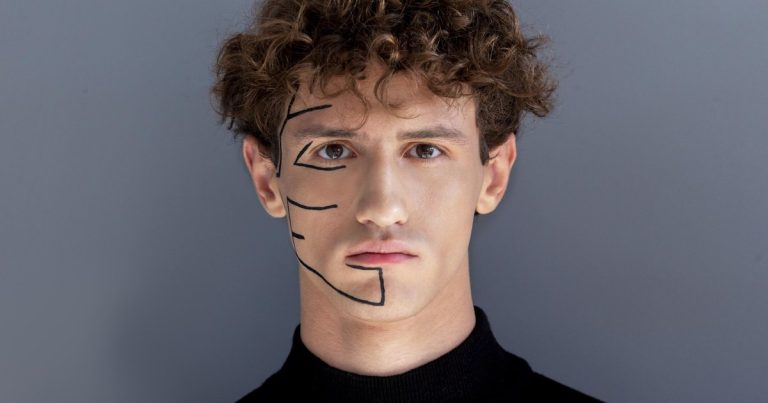
Toe reading uses the shape and position of the toes to describe someone’s personality or life. Face reading uses facial features. Both rely on meanings assigned by a reader or a tradition.
The practices differ in what they look at and how they explain it. You can try either for fun or as something to discuss, but neither can establish personality from appearance.
What is toe reading?
A toe reader looks at details such as toe shape, spacing, and position. They assign meanings to those details and may ask questions about the person’s experiences.
Imre Somogyi’s Reading Toes: Your Feet as Reflections of Your Personality, published in 1997, is one modern book about the practice. It describes one approach, so it should not be treated as the history of all toe reading.
The Southwest Institute of Healing Arts teaches another approach associated with KC Miller. Its description of toe reading describes a practice based on listening and asking questions about a person’s life. The school gives spiritual meanings to the toes. These are its beliefs, not established facts about the body.
What does a toe reading chart mean?
A chart lists the meanings a teacher or reader assigns to each toe. These may include communication, relationships, motivation, or feeling secure. Different charts can give different meanings, so check which book or teacher the chart comes from.
Ask how the reader reached a conclusion. Did it come from a visible feature, a rule in their system, or something you told them? These are different kinds of information.
A conversation about relationships might help you describe a habit or understand an experience. That does not mean the shape of a toe revealed it.
What do Egyptian, Greek, and Roman feet mean?
You may have seen diagrams labelled Egyptian, Greek, and Roman feet. These labels compare toe lengths. In the diagram below, the Egyptian foot has a big toe that is longest, the Greek foot has a longer second toe, and the Roman foot has several front toes of similar length.
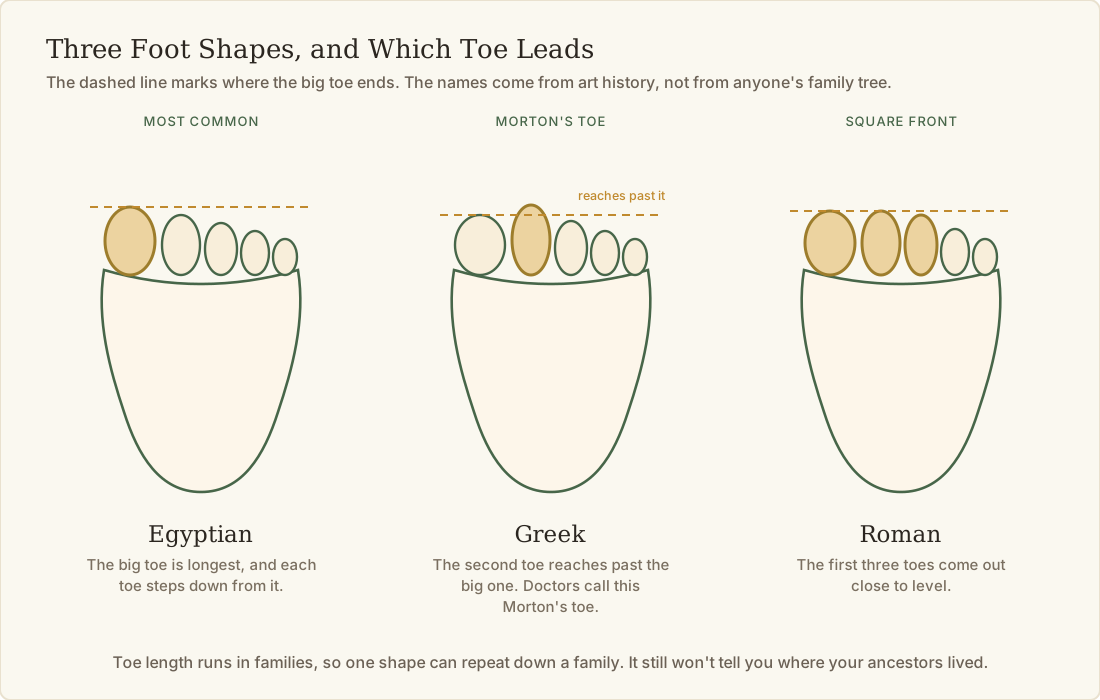
These labels describe the shapes shown in the illustration. They do not establish ancestry, nationality, temperament, or a person’s future. The same label may also cover feet that look noticeably different.
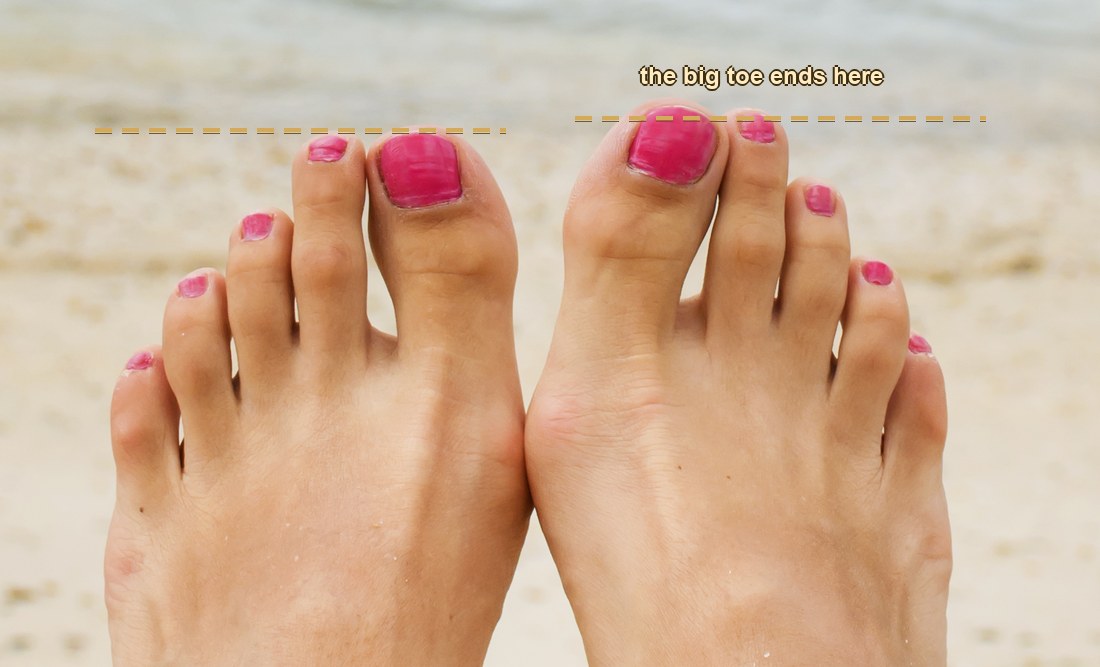
The photo above illustrates a comparison of visible toe lengths. It is a shape example, not a personality reading of the person pictured.
What does a face reader look at?
Face reading explores the forehead, eyes, brows, nose, mouth, jaw, and other facial features. Different traditions arrange these details into their own systems. Chinese mian xiang and Indian samudrika shastra are two starting points for learning about that variety.
A face reader may link a feature with being expressive, persistent, affectionate, or calm. FaceSage measures a photo, finds descriptions linked to those features, and uses AI to write a reading. You can explore the main areas in our face reading chart.
As with toe reading, measuring a feature does not prove what it means about personality. Different traditions agreeing does not prove it either.
Toe reading and face reading compared
| Question | Toe reading | Face reading |
|---|---|---|
| What does it look at? | Toe shape, spacing, position, and related details | Facial features, proportions, and overall shape |
| How are meanings chosen? | From the meanings taught by a particular teacher | From one or more face-reading traditions |
| What can a session offer? | Descriptions and questions to discuss | Descriptions of features and related personality ideas |
| What should it not claim? | That toes prove character, ancestry, or life events | That a face proves character, intentions, or relationship outcomes |
What about the research on faces?
Researchers study the quick judgments people make when they see a face. They look for patterns in how different people rate the same photos. For example, Oosterhof and Todorov’s work examined impressions of trustworthiness, dominance, and threat.
That research is about how a face looks to other people. It does not prove that traditional face reading can reveal character or that it is a more accurate personality test than toe reading.
Which one should you try?
Try toe reading if you are interested in the meanings readers assign to feet and toes. Try face reading if you want to learn what traditions say about facial features.
You can question or disagree with either reading. Do not rely on it to judge someone’s abilities, decide whether to trust them, or predict the future.
To explore face reading, start with your own photo in FaceSage. The scan is free. You’ll see your archetype and six first-impression scores, and you can buy the written reading if you want it.
FAQ
Does a longer second toe mean leadership? Some symbolic interpretations make that association. Toe length itself does not establish whether someone is a leader, and different readers may assign it different meanings.
Can toe shape tell me my ancestry? Names such as Egyptian or Greek foot are labels for an outline. They do not establish where a person or their ancestors came from.
Is every toe reading chart the same? No. Charts can reflect different teachers, books, or spiritual systems. Ask for the source of a chart before treating its meanings as a universal tradition.
Does FaceSage read toes? No. FaceSage works with facial photographs. It does not provide toe, foot, or palm readings.
Keep reading
What Is Face Reading and What Can It Tell You?
What Is Face Reading (Physiognomy)? Physiognomy is a folk art of fortune-telling that involves observing a person’s facial features, and strictly speaking,…
Can a Face Show a Zodiac Sign? Face Reading vs Astrology
The idea of trying to glimpse the secrets of the stars from between the eyebrows and eyes is quite interesting. Physiognomy is…