
Face reading by photo · The scan is free
Face reading
by photo.
Upload one clear photo and FaceSage reads the face for you, right in your browser. Your archetype and six first-impression scores are free.
Upload a photo for your face reading
One clear, front-facing photo is all it takes. The scan is free.
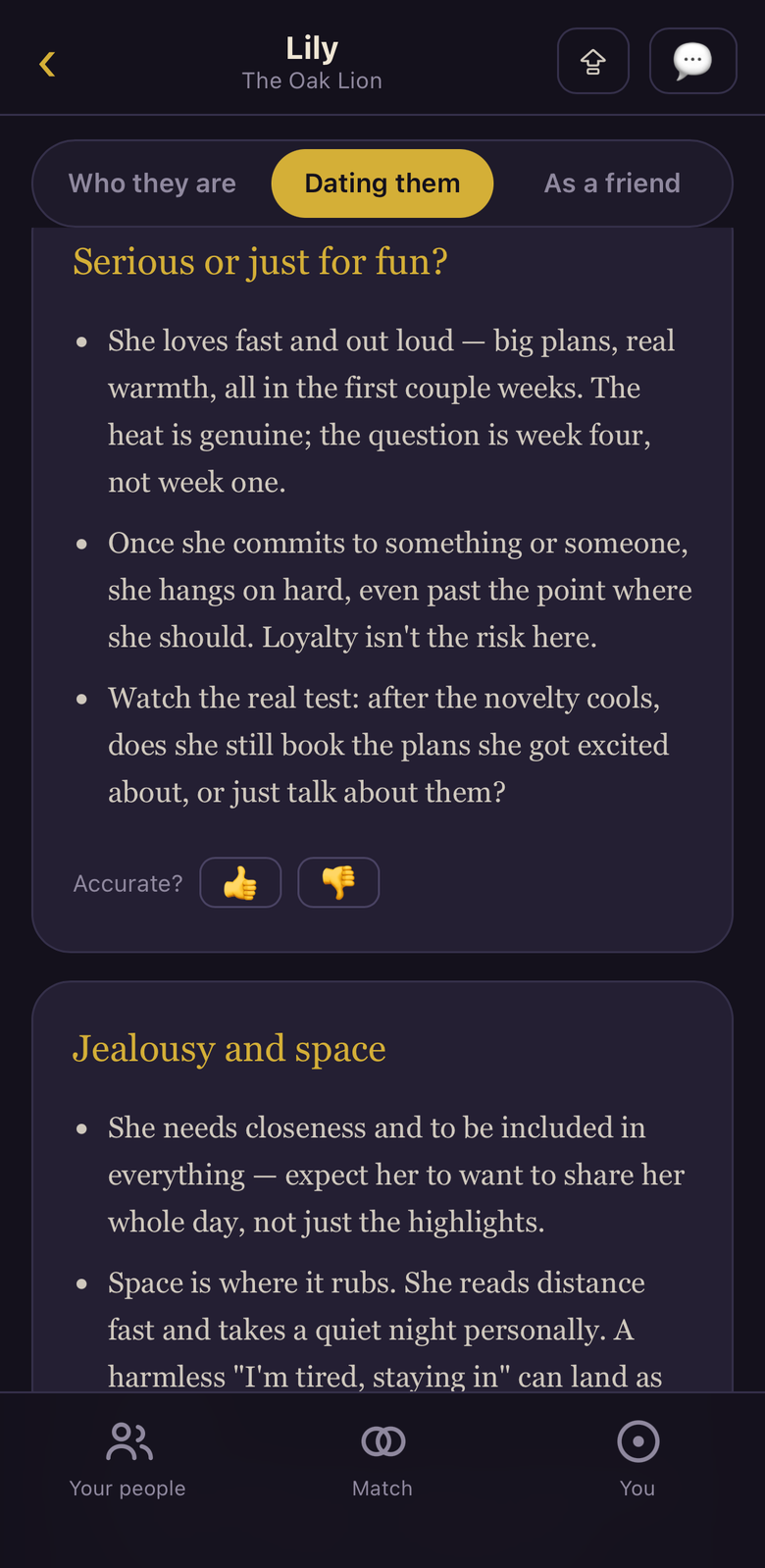
Your results from one photo.
Upload a photo and your free results show up right away. No email, no card.
Free with every scan
Your archetype
A name for how your face reads, like the Oak Lion or the River Swan, with a short description of the personality behind it.
Six first-impression scores
How your face comes across to people meeting you for the first time:
- Warmth
- Trust
- Competence
- Takes charge
- Social energy
- Presence
With a full reading
Your written personality reading
The traits and habits face-reading traditions link to your features, written for you.
Dating and friendship readings
How you are as a partner and as a friend, with scores like:
- Affection
- Long haul
- Space needs
- Loyalty
- Give and take
- Even temper
Five follow-up questions
Ask anything about your reading and get an answer based on it.
Three steps. No download.
FaceSage works in your browser, on your phone or your computer.
Choose a face
Upload a clear, front-facing photo. Start with yourself or someone you’re curious about.
See your first results
The app measures the face and shows the archetype name and first-impression scores.
Open the full reading
If you want the written reading, buy one read. It opens the character, dating, and friendship readings and five follow-up questions.
How face reading by photo works
FaceSage measures the eyes, brows, nose, lips and jaw in your photo, then looks up what face-reading traditions say about those features.
You get a named archetype and six scores for the first impression the photo gives. If you want more, one read opens the full written personality, dating and friendship readings.
You can get a face reading by photo by uploading a portrait to an AI face reader or sending one to a practitioner who offers photo readings. The reader examines visible facial features and connects them with an interpretive system, producing a report you can explore at your own pace.
For a beginner, the appeal is simple: a familiar photograph becomes an introduction to face reading. You can discover which features attract a reader’s attention, learn some traditional symbolism, and consider how the resulting themes relate to your experience.
What a face reading from a photo involves
A photo reading starts with what the image shows: the outline of the face, the eyebrows, the nose, the mouth, and the relationships between features. A practitioner interprets those details through a chosen tradition. An AI service uses software to produce its account; the process varies by provider.
For example, ReadFace AI’s explanation of its reports describes reviewing visible facial areas and organizing observations into sections about strengths, work, relationships, and reflection. This gives you an idea of the format a service might offer.
Chinese face reading, or mian xiang, supplies a rich visual vocabulary. Historian Livia Kohn describes a traditional map of five sacred mountains: the forehead, both cheekbones, nose, and chin, with the nose at the center. A reader using this map considers features as parts of a symbolic landscape. See Kohn’s study of Chinese physiognomy, page 252.
Such symbolism differs from describing an expression, which concerns how a face appears at a particular moment. Facial recognition has another purpose: matching a face to an identity. Neither task is the same as a traditional reading, and an AI face reader needn’t perform identity recognition to generate a report.
Choosing a photo-reading service
Start with a sample report. Look for explanations that connect a visible feature with an interpretation you can follow. A list of adjectives gives you less to explore than a passage explaining which detail prompted the description and what framework it belongs to.
Your interests can guide the choice. For cultural learning, look for a named tradition and explanations of its terms. For reflection, look for questions or themes you can connect to everyday life. If you prefer discussing the interpretation, check whether a practitioner offers follow-up conversation or whether a tool accepts questions.
Before choosing a website, app, or practitioner, check these practical details:
- Report scope: Which features and topics are covered? Is the sample representative of what you receive?
- Access and cost: Is an account required? Does “free” mean a complete report or a preview? Check credit limits and any subscription renewal.
- Photo handling: What is retained, for how long, and how can you delete the image and report?
- Other uses: Does the service send photos to outside processors, use uploads for training, or create shareable reports?
These checks help you choose an experience that matches your curiosity and your comfort with sharing a portrait.
Preparing a photo for a reading
Choose a photograph that makes the requested features easy to see. ReadFace AI’s photo guide, for example, recommends one person facing forward, with the forehead, eyes, nose, mouth, and jaw visible. It identifies blur, backlighting, and harsh shadows as obstacles to reviewing those areas.
Use this sequence before uploading:
- Read the image requirements. Check accepted formats, file size, and whether the reader requests a frontal portrait or additional views.
- Find even light. Take the picture where both sides of your face are clearly visible. Avoid a bright window directly behind you.
- Keep your head level. Use a straightforward pose and a relaxed expression, following any provider-specific instructions.
- Check the details. Move hair or accessories that obscure requested features. Skip reshaping filters; check whether the service gives instructions about makeup.
- Review the upload. Use your own image or obtain the pictured person’s permission, then confirm you’re comfortable with the terms.
A simple portrait is enough to begin; elaborate styling adds little to this exercise.
How accurate is face reading by photo?
A clear photo helps a reader inspect visible features. The meanings attached to those features are a separate question. Traditional interpretations can be explored as cultural symbolism and prompts for reflection; they aren’t established measurements of your personality or reliable forecasts of your future.
Research into AI personality prediction has found some associations. A 2020 study by Kachur and colleagues used photographs and self-reported personality questionnaires from 12,447 adults. Its models achieved an average correlation of 0.243 between predicted and questionnaire scores on held-out participants. That is a modest statistical relationship, not a percentage of people read correctly. The authors acknowledged that photographic choices and other image cues couldn’t be separated from facial structure, and the Russian-speaking sample limited generalization.
The particular portrait matters, too. In Todorov and Porter’s experiments on first impressions, different photographs of one person produced differences in social judgments comparable to those between people. These were observers’ impressions, rather than measurements of the subjects’ actual character.
Neither finding validates a particular commercial report or predictions about future events. A precise-looking score needs an explanation of what it measures and evidence of its accuracy. For your own reading, let the report offer ideas to consider while your experiences supply the personal detail.
Making sense of your report
Read a face reading report with the portrait beside it. Take one passage at a time and follow its movement from feature to meaning.
Imagine a hypothetical passage describing the nose’s outline, calling it the “central mountain,” then discussing balance across the face. The outline is something you can inspect. The mountain is traditional terminology. You can now see how the writer builds an interpretation, and identify where you’d like more explanation.
If another passage introduces a theme such as persistence, connect it to a specific project: what kept you going, and when did you change direction? Your answer makes the theme personal without requiring every description to fit.
Ready to explore a report alongside your own portrait? Try a photo-based reading with FaceSage. Start with the feature that interests you most, follow its interpretation, and see what it brings to mind.
Featured on









What people say after a reading
“I ran his photo the night before our first date. It didn’t tell me he was a bad person or my soulmate — it told me to pay attention to whether the plans he suggested actually turned into dates. They didn’t, three times in a row. Having one concrete thing to watch for instead of a vague feeling made the whole thing easier to walk away from.”
“My girlfriend and I tried the couples match half as a joke, six months into our relationship. The section on jealousy and space described a recurring argument we have about weekends almost exactly. Some of the suggested working rules are things we genuinely say to each other now. I didn’t expect that level of accuracy from an app.”
“My roommate got Iron Hawk and I got River Swan, and our group chat talked about nothing else for a week. Everyone ended up sending in their photo. The cards are the fun part, but when you sit down and read your own report privately, some of it is surprisingly specific.”
“I’ve tried and deleted plenty of horoscope-style apps, so my expectations were low. What won me over is what this one doesn’t say. Where my face shows nothing, it says nothing — no filler. And it never claims someone is trustworthy, only how they’re likely to come across to others. Because of that restraint, the parts it did commit to felt earned.”

“I used the friend match before signing a lease with someone I’d only known a couple of months. ‘Who keeps the friendship alive’ and ‘what spending time together looks like’ were questions I hadn’t thought to ask. We went through the potential clash section together, and it turned into the easiest difficult conversation I’ve had. Our house rules actually came out of it.”

Before your first reading
How does face reading by photo work?
You upload one photo. The app measures your facial features on your device, matches them to descriptions from face-reading traditions, and shows your archetype and first-impression scores.
Which photo gives the best reading?
A well-lit photo with one face looking straight ahead, a relaxed expression and visible eyes. Avoid sunglasses, heavy filters and a strong head tilt.
Can I get a reading from a friend's photo?
Yes, with their permission. FaceSage never notifies the person in the photo.
Is FaceSage free?
The scan is free. You get an archetype and six first-impression scores for every photo, with no email or card. The written character, dating, and friendship readings and two-person matches are paid.
Will the person in the photo be notified?
FaceSage does not notify or message the person pictured. Only upload photos you have permission to use.
Do I need to download an app?
No. FaceSage works in your browser on a phone or computer.
Ready for your photo reading?
Pick a clear photo and see your archetype and scores in a minute. The scan is free.
Read my face free →No download. No card needed to scan.