Micro-Expressions vs Face Reading: What Is the Difference?
Okay, this is a very interesting and insightful topic. Combining traditional Chinese physiognomy with modern micro-expression psychology can provide us with a multi-dimensional perspective for observing and understanding others.
It needs to be emphasized that:
- Microexpression psychology is based on scientific evidence and studies the brief (1/25 second) facial muscle movements that are not under conscious control, revealing true emotions.
- Traditional physiognomy is more of a collection of empirical philosophy and cultural symbols, lacking scientific verification, but some of the observations behind it can be linked to long-established muscle habits and personality traits.
When we combine the two, the core idea is to use micro-expression psychology to explain “momentary truth” and use the assumptions provided by physiognomy to observe “long-term muscle memory and personality tendencies,” and then verify or question each other.
Let’s combine these points in detail from several aspects:
The Eyes: Windows to the Soul
The Eyes in Face Reading
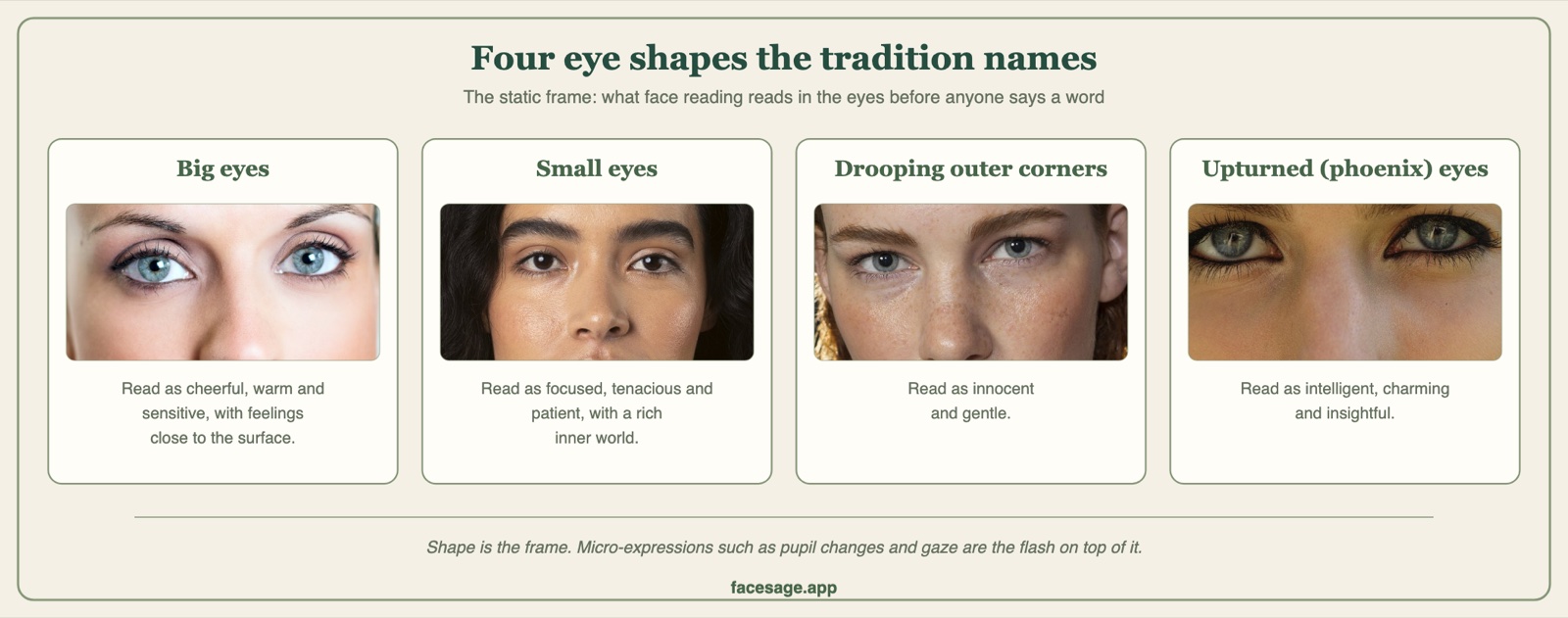
- Big eyes: Usually considered cheerful, enthusiastic, and sensitive, but may also be prone to emotional outbursts.
- Small eyes: are usually considered to be focused, tenacious, patient, and have a rich inner world.
- Drooping corners of the eyes: appear innocent and gentle.
- Upturned eyes (phoenix eyes): are considered intelligent, charming, and insightful.
Eye Micro-Expressions
- Pupil dilation: indicates interest, excitement, or attraction (not under conscious control).
- Frequently avoiding eye contact: This may indicate nervousness, shame, or concealment.
- Prolonged staring: This could be a provocation, focused attention, or an attempt to exert pressure.
- Looking upwards (left/right): This usually indicates that you are recalling or thinking.
- Looking down: This may indicate that you are experiencing some kind of emotion (such as shame or guilt).
Reading the Eyes With Both Methods
- A person with upturned eyes (in facial features) might give the first impression of being “shrewd.” If, at the same time, their pupils dilate slightly during conversation (micro-expression), it can be inferred that they have genuine interest in the current topic. Conversely, if their eyes dart away and their gaze is downward, it may indicate that although they appear shrewd, they are currently experiencing avoidance or negative emotions.
- A person with droopy eyes (in facial features) gives the impression of being “gentle”. If they can maintain a steady and sincere gaze (micro-expressions) during communication, then their gentleness is likely genuine and reliable. If their eyes wander, then their “gentleness” may just be a static facade, and they may actually be insecure or lack confidence.
The Eyebrows: Flags of Emotion
The Eyebrows in Face Reading
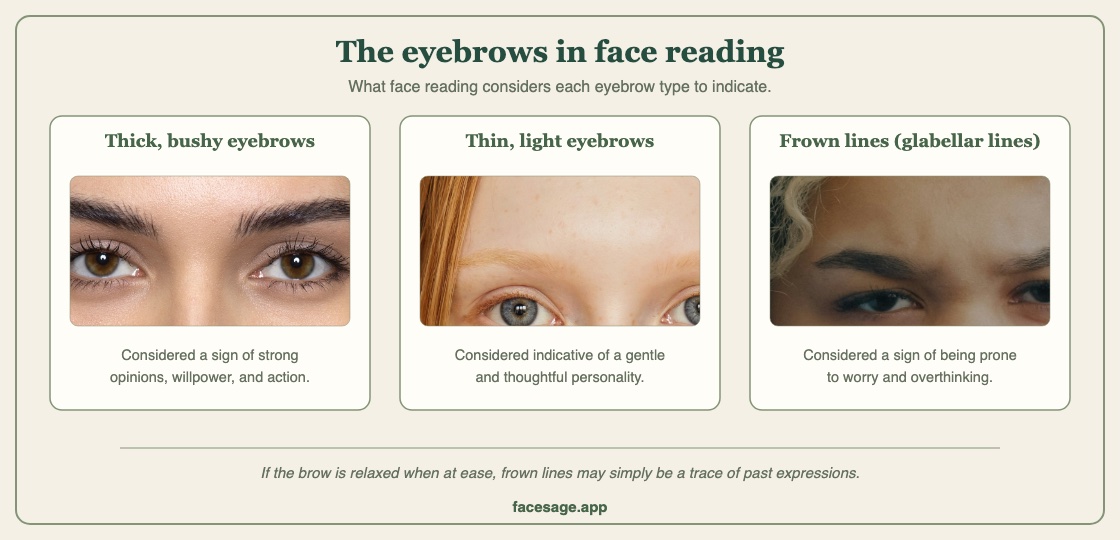
- Thick, bushy eyebrows: These are considered a sign of strong opinions, willpower, and action.
- Thin, light eyebrows: These are considered indicative of a gentle and thoughtful personality.
- Well-developed frown lines (glabellar lines): This is considered a sign of being prone to worry and overthinking.
Eyebrow Micro-Expressions
- Eyebrows rising rapidly (in a flash): indicates surprise, compliance, or greeting.
- Raised single eyebrow: indicates doubt or confusion.
- Frowning: indicates worry, pain, or focus.
- Raised eyebrows and horizontal lines on the forehead: Indicates fear.
Reading the Eyebrows With Both Methods
- A person with prominent frown lines (in facial features) may be in a state of deep thought for extended periods. If, during a calm conversation, their brow remains unconsciously furrowed (micro-expression), this suggests they may have persistent anxiety. Conversely, if their brow is relaxed when they are at ease, then the frown lines may simply be a trace of past facial expressions.
- A person with thick, bushy eyebrows (in physiognomy) who raises one eyebrow when expressing their opinion powerfully conveys their doubt and disapproval, reinforcing their image as someone who “has their own opinions.”
The Mouth and Lips: Restraint and Expression
The Mouth in Face Reading
- Big mouth: is considered to be extroverted, articulate, and ambitious.
- Small mouth: is considered to indicate caution, conservatism, and focus.
- Upturned corners of the mouth: Even when not smiling, it looks like you are smiling, and it is considered to be optimistic and approachable.
- Downturned corners of the mouth: This is often associated with stubbornness, pessimism, and severity.
Mouth and Lip Micro-Expressions
- Pressing your lips together: indicates stress, anxiety, restraint, and determination.
- One corner of the mouth turned up (mocking): indicates contempt or disdain.
- Lips slightly parted: indicates relaxation, surprise, or preparation to speak.
- Licking or biting one’s lips: usually indicates nervousness or self-comfort.
Reading the Mouth With Both Methods
- A person with naturally downturned corners of the mouth (in physiognomy) tends to give off a “stern” impression. If, after hearing some news, one corner of their mouth curls up in a mocking smile (micro-expression), then their contemptuous attitude is very obvious, which aligns with the presuppositions of physiognomy.
- A person whose lips naturally turn up (in facial features) always looks “happy”. But if when he smiles, only his lips move and the muscles around his eyes (wrinkles at the corners of his eyes) are not involved (the “Du Xiang smile” in micro-expressions), then his smile may be a polite or fake smile, rather than a genuine smile.

The Nose and Chin: Confidence and Decisiveness
The Nose and Chin in Face Reading
- A high, straight nose: This is considered a sign of assertiveness, confidence, and leadership.
- A wide nose tip: is considered a sign of a generous and tolerant person.
- Square chin: Considered to be determined and decisive.
Nose and Chin Micro-Expressions
- Wide-open nostrils: indicates anger or emotional agitation.
- A slight wrinkle on the nose: indicates disgust or aversion.
- Chin protruding forward: indicates provocation or defensiveness.
- Touching your nose/pursing your lips: This may be a comforting gesture when lying.
Reading the Nose and Chin With Both Methods
- A person with a square jaw (facial feature) who protrudes their chin forward during an argument (micro-expression) reinforces their image of being “firm and unyielding”.
- A confident person with a high, straight nose (facial feature) will unconsciously wrinkle their nose slightly when they smell an unpleasant odor or hear an unpleasant opinion (micro-expression). This reveals their true aversion, which, combined with their confident appearance, may manifest as a clear attitude of rejection.
Key Takeaways for Combining Micro-Expressions and Face Reading
Combine Static and Dynamic Perspectives
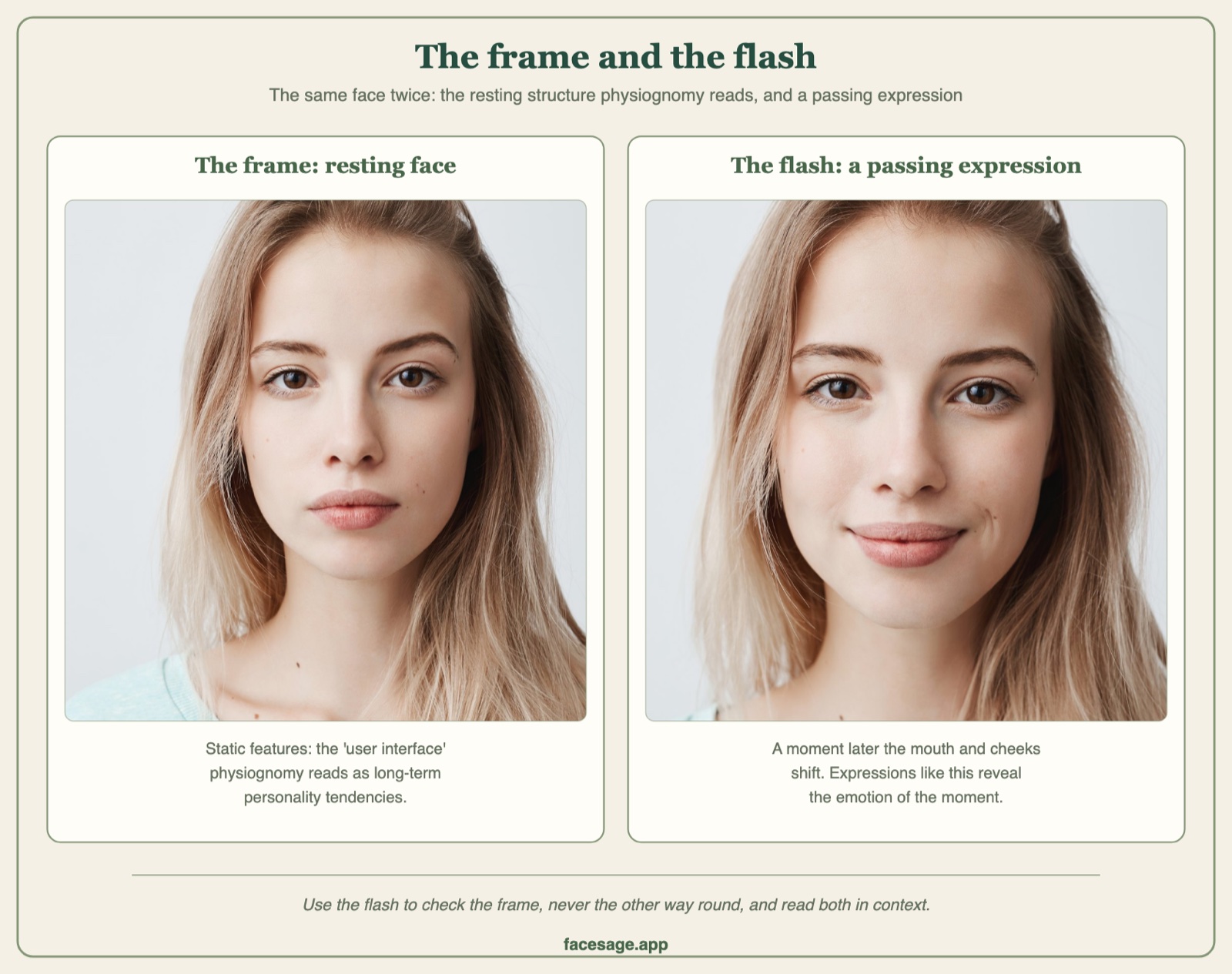
View facial features as a person’s “static user interface,” while micro-expressions are the “real process” running in the background. By observing dynamic micro-expressions, we can verify or correct the initial impression drawn from static facial features.
Read From the Inside Out
Physiognomy is more about “inferring the inner from the outside,” while micro-expressions are “reflecting the inner on the outside.” When combining them, the core should be the true emotions revealed by micro-expressions, with physiognomic features used as supplementary references for personality tendencies.
Avoid Stereotypes
The most important point is that you should never judge a person solely based on their appearance. Facial features offer a possibility, while micro-expressions reveal a fleeting truth. A person with small eyes may be equally enthusiastic, and a person with downturned lips may be full of kindness.
Make a Comprehensive Judgment
Never look at an expression or facial feature in isolation. A more accurate judgment requires considering the context, body language, and a range of facial expressions.
Through this combination, you can not only more keenly capture other people’s momentary true emotions, but also gain a more concrete and multi-faceted understanding of a person’s long-term personality tendencies. It will become a very useful tool for you in interpersonal communication, workplace management, and emotional exchange.
Keep reading
What Is Face Reading and What Can It Tell You?
What Is Face Reading (Physiognomy)? Physiognomy is a folk art of fortune-telling that involves observing a person’s facial features, and strictly speaking,…
Face Reading vs Body Language, and Why You Need Both
Why Face Reading Includes Body Language Physiognomy theory holds that to improve the accuracy of face reading, one must not only observe…